
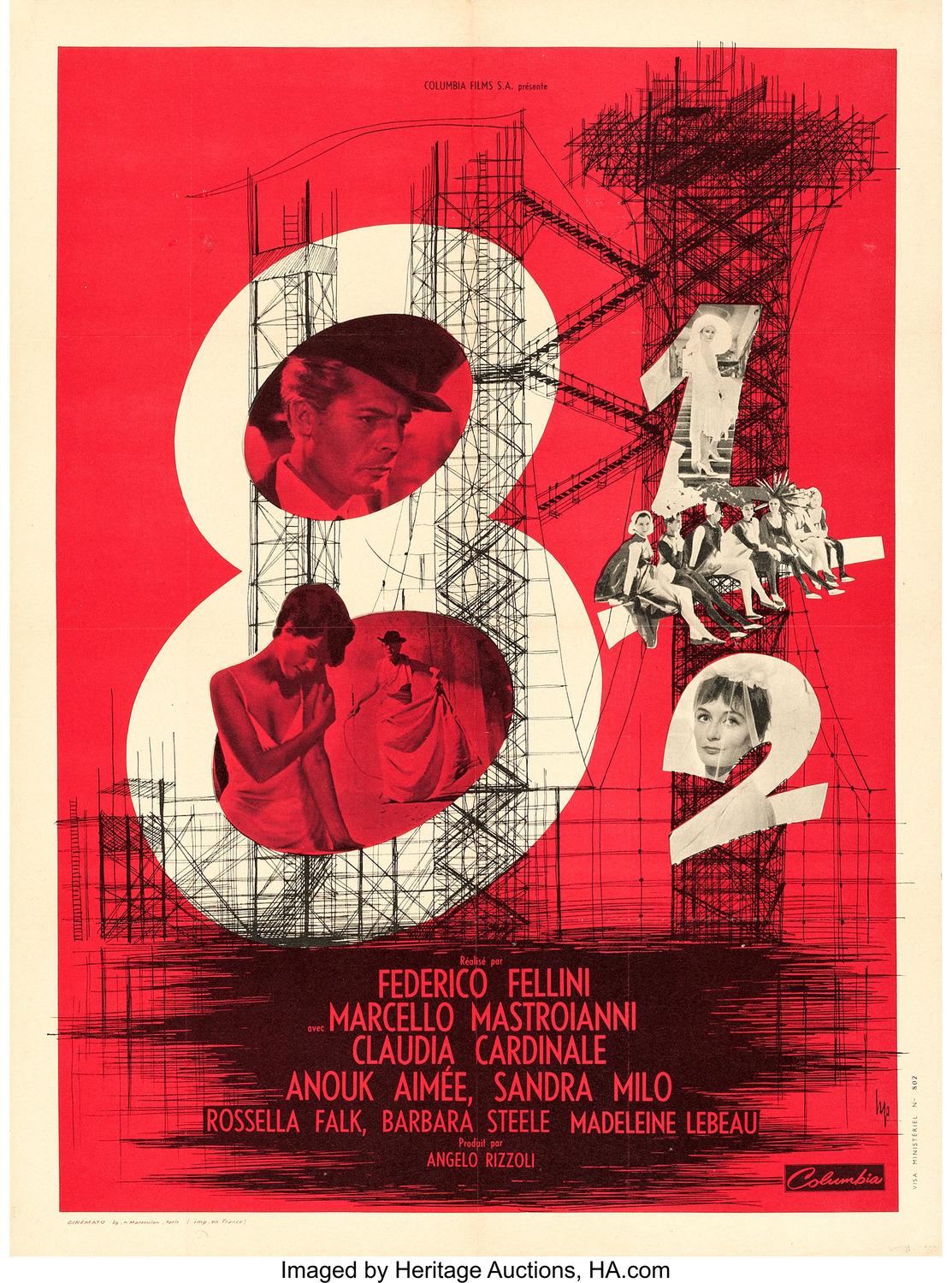
What the Film Is About
Federico Fellini’s 8½ is a film saturated with the anxieties and desires of artistic creation. At its center is Guido Anselmi, a celebrated director suffering from a profound creative block as he attempts to make his next film. Instead of following a conventional plot, the film embarks upon a deeply personal, inner journey. As Guido wanders through a haze of memories, fantasies, and present-day pressures, the narrative charts his emotional descent into confusion—and, finally, his partial reconciliation with himself and his craft.
The film is less about externally-driven events than it is about Guido’s psychological turmoil. Torn between obligations to his work, the women in his life, and his own ideals, Guido embodies the tension between inspiration and paralysis. 8½ is ultimately about a creator confronting the impossibility of satisfying everyone—and perhaps, even himself—while searching for authenticity in both art and life. This tension provides the film’s overall direction and emotional shape.
Core Themes
One of the central themes of 8½ is the crisis of identity—particularly as it relates to the creator’s role in society. Guido’s struggle to make a meaningful film in the face of commercial, personal, and existential pressures reflects Fellini’s own ambivalence about artistic purpose. The film interrogates the nature of inspiration: What drives a person to create? Is art an act of self-expression or a response to external expectations?
Another major theme is escapism. Guido is constantly fleeing into memories, daydreams, and fantasies, using them both as sanctuaries and as barriers to productive action. This theme resonates with a post-war Italy grappling with rapid modernization and social change, where the past was both alluring and burdensome, and the future uncertain.
Additionally, the film explores the complex relationships between men and women. Guido’s personal life is littered with fractured, unsatisfying relationships, each loaded with yearning and disappointment. These encounters highlight the broader theme of emotional and erotic longing, often intertwined with the search for maternal comfort and unconditional acceptance.
Upon release in 1963, these themes spoke to anxieties about identity, purpose, and alienation in a society moving away from traditional values toward modernity. Today, 8½ remains relevant for any artist, thinker, or individual grappling with creative roadblocks, conflicting roles, or the ever-present demand for authenticity in a complex and noisy world.
Symbolism & Motifs
The film’s structure and imagery are glutted with recurring symbols and motifs that deepen its exploration of the psyche. One major motif is that of the circus—representing the chaos and performative nature of both film-making and life itself. The ringmaster, the parade of odd figures, and the spectacles evoke the sense of life as a staged act, where the line between reality and illusion is constantly blurred.
Another recurring symbol is the use of water—baths, fountains, and spas serve as places of purification, regression, and the dissolution of boundaries between imagination and reality. Guido seeks solace in these watery environments, but they also often signal escape rather than genuine renewal.
Mirrors and reflections are prominent throughout the film, underscoring Guido’s fractured identity and the challenge of authentic self-perception. The director is not only confronted with multiple versions of himself but also with expectations reflected back at him by colleagues, lovers, and society.
Light and shadow act as vivid visual metaphors. The bright, overexposed visuals of Guido’s fantasies contrast with the more subdued, shadowy tones of his reality. This dynamic emphasizes the allure of fantasy and the discomfort or even bleakness of the real world.
Key Scenes
Key Scene 1
The film’s opening dream sequence immediately immerses viewers in Guido’s anxious psyche. In this scene, Guido is trapped in a car during a traffic jam, suffocating as he struggles to escape. Suddenly, he floats out of the car and soars above the city before being pulled back down to earth by a rope. This surreal, wordless sequence introduces major threats and desires: the anxiety of confinement, the wish for transcendence, and the persistent force of reality anchoring him in place. It encapsulates the film’s central tension—between liberation and entrapment, inspiration and exhaustion—laying bare Guido’s internal world from the outset.
Key Scene 2
A pivotal moment occurs during the harem fantasy sequence, in which Guido imagines himself in control of all the women in his life. Initially, he is the adored ringmaster of a lavish, circus-like parade, with all his lovers coexisting harmoniously, subject to his whim. However, the fantasy unravels as the women revolt against him, exposing his inability to manage his competing desires and responsibilities. This allegorical scene exposes Guido’s selfishness and infantilism, but also his deep yearning for unity and harmony. Paradoxically, the fantasy reveals how his idealization of women (and of himself) is doomed to collapse under the weight of lived reality. The sequence interrogates the intersection of power, desire, and gender, showing the futility of trying to mold others to fit one’s narrative.
Key Scene 3
The final scene, the film’s celebrated “dance of reconciliation,” gathers Guido, his cast and crew, and the symbolic figures from his past in a circular, carnival-like procession. After rejecting both the pressures of the film business and his own momentary impulses to retreat into despair, Guido appears to accept the imperfection and messiness of life and art. This culminating vision suggests that creative peace, if it exists, lies in embracing the contradictions and chaos within oneself and others. Rather than resolving his conflicts, Guido learns to coexist with them—a message echoed in the joyous, if ambiguous, closing procession. The scene powerfully underlines 8½’s endorsement of acceptance over perfection or closure.
Common Interpretations
Critics and audiences have long interpreted 8½ as a meditation on the struggles of artistic creation, particularly in the context of cinema. Many view Guido (and by extension, Fellini) as a stand-in for all artists contending with creative block, self-doubt, and the parade of expectations. The film is widely hailed as an introspective commentary on the movie-making process itself—a “film about making a film”—and the crisis of meaning that can follow professional success.
Some interpretations focus on the autobiographical elements, reading the film as Fellini’s confession of insecurity and exhaustion from public scrutiny. Others see it as a broader philosophical statement about the search for meaning in modern life—a kind of existential odyssey where personal authenticity is perennially under threat.
Another common reading centers on the film’s portrayal of male desire and fantasy. Feminist critics in particular have scrutinized the ways Guido’s relationships with women reveal not only his failings but also the cultural assumptions of his era. Viewers generally agree, however, that the film resists simplistic solutions: its very ambiguity is part of its message about the messiness of human experience.
Films with Similar Themes
- All That Jazz – Bob Fosse’s semi-autobiographical film echoes 8½’s reflection on artistic obsession, mortality, and the blurred borders between life and performance.
- Synecdoche, New York – Charlie Kaufman’s film explores the ordeal of creation and identity, similarly blurring dream and reality as its protagonist loses himself in the act of making art.
- Nostalghia – Andrei Tarkovsky’s film addresses spiritual crisis, yearning for the past, and the tension between personal identity and creative vision, resonating with many of 8½’s existential dilemmas.
- Birdman – Alejandro González Iñárritu’s film satirizes both artistic ego and existential anxiety, focusing on a performer’s battle with irrelevance, self-doubt, and the pressure to produce something meaningful.
In sum, 8½ is a film that speaks hauntingly and humorously to the universal confusion that arises when facing one’s own limitations. It ultimately argues for the dignity and necessity of embracing imperfection—both personally and artistically. Rather than providing easy answers or a comforting finale, Fellini’s masterpiece invites us to find meaning in the incoherence and contradictions of life. In doing so, it remains one of the cinema’s most candid, self-aware, and enduring explorations of what it means to be human in the modern world.