
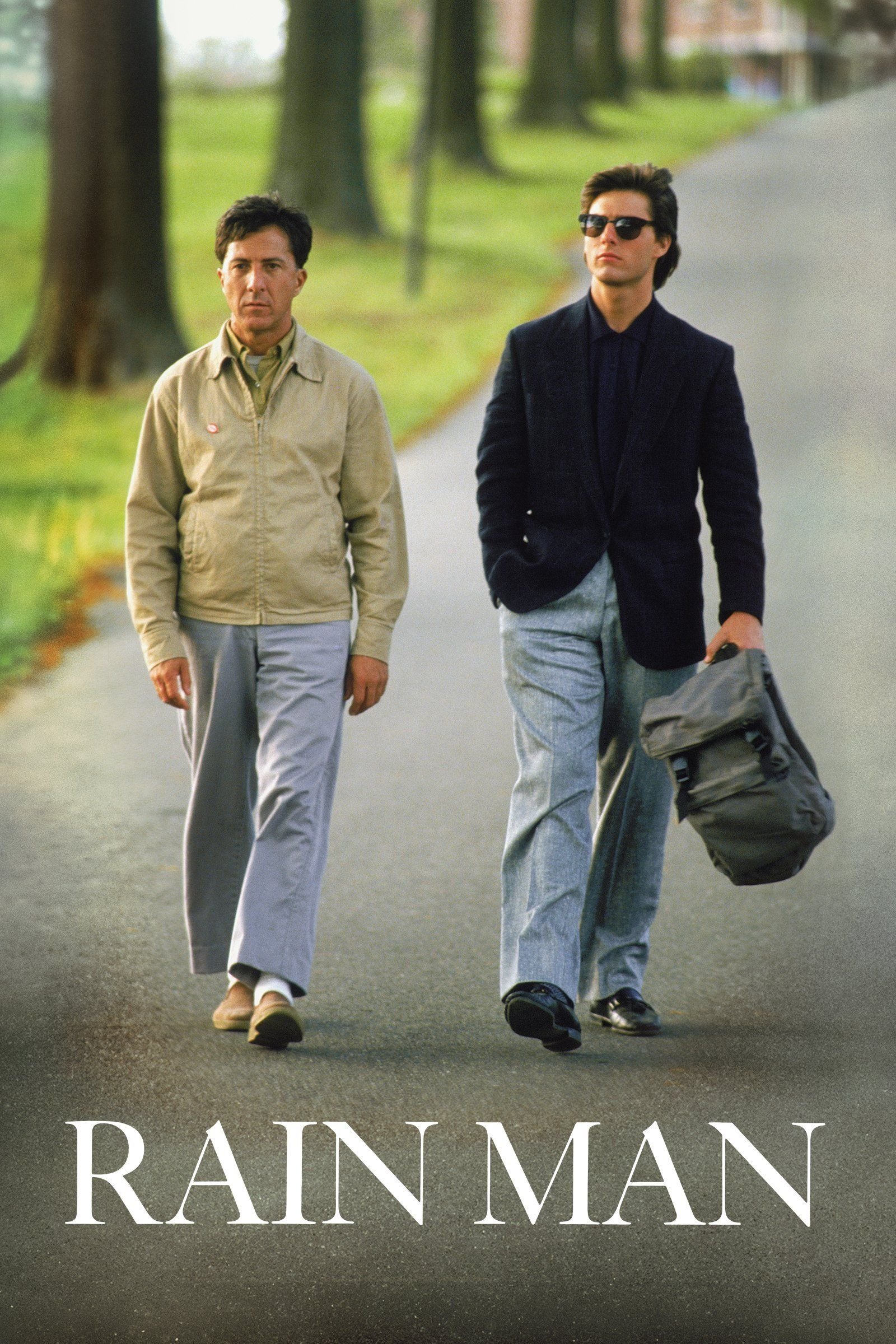
When I first watched “Rain Man,” I felt an immediate tug—a sense that I was witnessing not just the transformation of its characters, but also a challenge to my assumptions about connection, empathy, and the boundaries of human experience. This 1988 classic, directed by Barry Levinson, lingers long after the credits roll, not because of its surface plot, but due to the rich tapestry of meaning and emotion woven through every moment of its journey.
The Arithmetic of Alienation
“Rain Man” presents me with an arithmetic of alienation—Tom Cruise’s Charlie Babbitt is not just distant from his brother Raymond, but also cut off from his own emotional core. As I navigate his arc, I’m struck by the way the film uses Raymond’s unique worldview to expose the limits of Charlie’s own understanding. Numbers come easily to Raymond (Dustin Hoffman), but emotional calculations are nearly impossible. In a sense, Charlie is his mirror opposite: emotionally reactive, impulsive, skilled in social maneuvering, yet unable to solve the equation of intimacy.
The film crafts this disconnection through patient, subtle details. The gulf between the brothers is not simply behavioral, but existential. Their vastly different approaches to the world ask me to consider: what does it mean to truly see and value another person? Rain Man suggests that alienation is as much about failing to listen as it is about any inability to communicate.
Roads Taken and Not Taken: The Cinematic Journey
On its surface, “Rain Man” is a road movie, but for me, the journey is internal—a physical passage that mirrors an emotional and philosophical voyage. The classic signifiers of the American road trip become sites of revelation: motels, open highways, diners, and casinos. Each setting pushes Charlie and Raymond into new confrontations with each other and with their own limitations. The camera often lingers on the landscape rolling past the car windows, a poignant reminder of the world’s vastness compared to the intimate, fraught space between two brothers.
Every stop along their journey becomes an opportunity for rebirth and recognition, a chance for Charlie to move beyond self-interest toward genuine concern. I’m reminded, watching these episodes unfold, how the American road film genre has always used travel to symbolize the search for self. “Rain Man” deepens this tradition by making the most challenging terrain that of the human heart.
Communication Beyond Words: The Limits of Language
What resonates with me most in “Rain Man” is the film’s insistence that communication is not merely about words. Raymond’s language is often literal, repetitive, or obscure. He is comfortable with ritual and routine, lost without them. The world, for Raymond, is a cacophony of unpredictable sensations—and so he clings to the safety of the familiar. The film pushes me to question the tyranny of so-called “normal” communication, suggesting that the most meaningful exchanges happen in moments of silence, gesture, and presence.
The scenes in which Charlie struggles to interpret Raymond’s needs are especially affecting. There is a raw vulnerability in these moments; I see Charlie learning to listen, to notice, and to accept the idiosyncrasies that define his brother’s existence. Rain Man’s subtext is clear: empathy is not about fixing or changing the other, but about meeting them where they are.
The Casino Metaphor: Calculating the Value of a Human Life
I find the Las Vegas casino sequence emblematic, not simply as a turning point in the plot, but more so as a metaphor for the way the world assigns value. In a place built on chance and calculation, Raymond’s gifts suddenly become profitable, turning him from a burden into an asset. The temporary reversal of roles—Charlie depending on Raymond for success—forces both the characters and me as a viewer to reconsider what is truly valuable.
The casino floor, with its relentless noise and unpredictable outcomes, becomes a crucible: Charlie and Raymond are outsiders in an environment that prizes luck, skill, and quick thinking. Yet it is Raymond’s difference—the very thing that alienates him from society—that offers the brothers a fleeting sense of triumph. The irony is not lost on me: in a world obsessed with profit, the film asks what cannot be measured or won, but must be experienced, suffered, and cherished.
Rain Man as a Reflection on American Manhood
As I experience “Rain Man,” I’m drawn to its subtle meditation on American masculinity. Both Charlie and Raymond are shaped by cultural expectations of what it means to be a man: independence, emotional reserve, economic success. Charlie’s initial coldness reflects a culture that prizes achievement over vulnerability, while Raymond’s difference is medicalized, institutionalized, rendered invisible.
The film’s emotional core, for me, lies in the slow collapse of Charlie’s old armor. He must unlearn the lessons of detachment and control, opening himself to the pain and beauty of caring for someone who will never meet the world’s narrow standards. In guiding Raymond through the chaos of everyday life, Charlie is forced to abandon his self-image as a master of his own fate.
This is not a story of victory or healing in the traditional sense. Rather, it is a reckoning with the costs of suppressing tenderness, the necessity of embracing weakness, and the redemptive power of letting go.
Performances as Windows to the Soul
I cannot discuss “Rain Man” without acknowledging the spellbinding performances at its center. Dustin Hoffman immerses himself in Raymond with precision and respect, never reducing the character to stereotype or sentimentality. Every gesture and vocal inflection is calibrated, turning Raymond’s routines into a language of their own. Hoffman’s performance insists on the dignity of a life that cannot be neatly categorized or explained.
Tom Cruise, as Charlie, offers a study in transformation. The role is deceptively difficult: he must make Charlie’s journey from selfishness to understanding believable, without slipping into melodrama. I am especially moved by the vulnerability that creeps into Cruise’s performance as the film progresses—the moments when words fail, and only presence remains.
Together, Hoffman and Cruise embody the film’s core question: what happens when one is forced to see, love, and accept another, not in spite of their difference, but precisely because of it?
Rituals of Safety: Autism, Representation, and the Fear of Change
“Rain Man” arrived at a moment when public understanding of autism was limited—a fact that complicates my response to its narrative. While I am aware of valid critiques regarding the accuracy and scope of its depiction, I am nevertheless moved by the film’s compassion. The rituals that govern Raymond’s days—counting, routines, favorite television shows—are not simply quirks, but defenses against a world that overwhelms. The film invites me into this experience, using sound design and visual repetition to evoke the anxiety and relief that structure brings.
Raymond’s inflexibility is cast not as deficiency, but as a rational response to unpredictability. For Charlie, these same rituals initially appear as obstacles, but over time, he comes to respect their necessity. In this, I see a broader statement about acceptance—not as resignation, but as an active embrace of difference.
Inheritance, Memory, and the Scars of the Past
At its heart, “Rain Man” is a film about inheritance—not just of money, but of wounds, memories, and unresolved longing. Charlie’s resentment over his father’s will is a proxy for deeper pain: the feeling of having been overlooked, misunderstood, and unloved. The revelation of his childhood bond with Raymond, the titular “Rain Man,” exposes an aching vulnerability beneath his bravado.
The film places memory at the center of family dynamics, suggesting that what we inherit is not just possessions, but patterns of fear and hope. Charlie’s journey is one of re-membering, both in the sense of recalling and reassembling the fragments of his own identity. As he reconnects with Raymond, he recovers a part of himself long denied.
Resisting Sentimentality: A Story Without Easy Answers
What I admire most about “Rain Man” is its refusal to offer tidy resolutions. The film resists the lure of sentimentality—Raymond does not suddenly become “cured,” nor does Charlie find a happily-ever-after with his brother. Their final separation is bittersweet, marked by newfound understanding but also the acknowledgment of lasting difference.
I’m left with a sense of ambivalence, one that feels honest and earned. The film suggests that love is not always about transformation or rescue, but about bearing witness—standing alongside another in their particularity, honoring both connection and separation. Rain Man’s ultimate triumph, for me, lies in its insistence on the dignity of imperfection.
Films That Echo Rain Man’s Emotional Resonance
- One Flew Over the Cuckoo’s Nest
- Midnight Cowboy
If you’re curious about how this film was originally perceived or how it compares to similar works of its era, these resources may be helpful.
🎬 Check out today's best-selling movies on Amazon!
View Deals on Amazon