
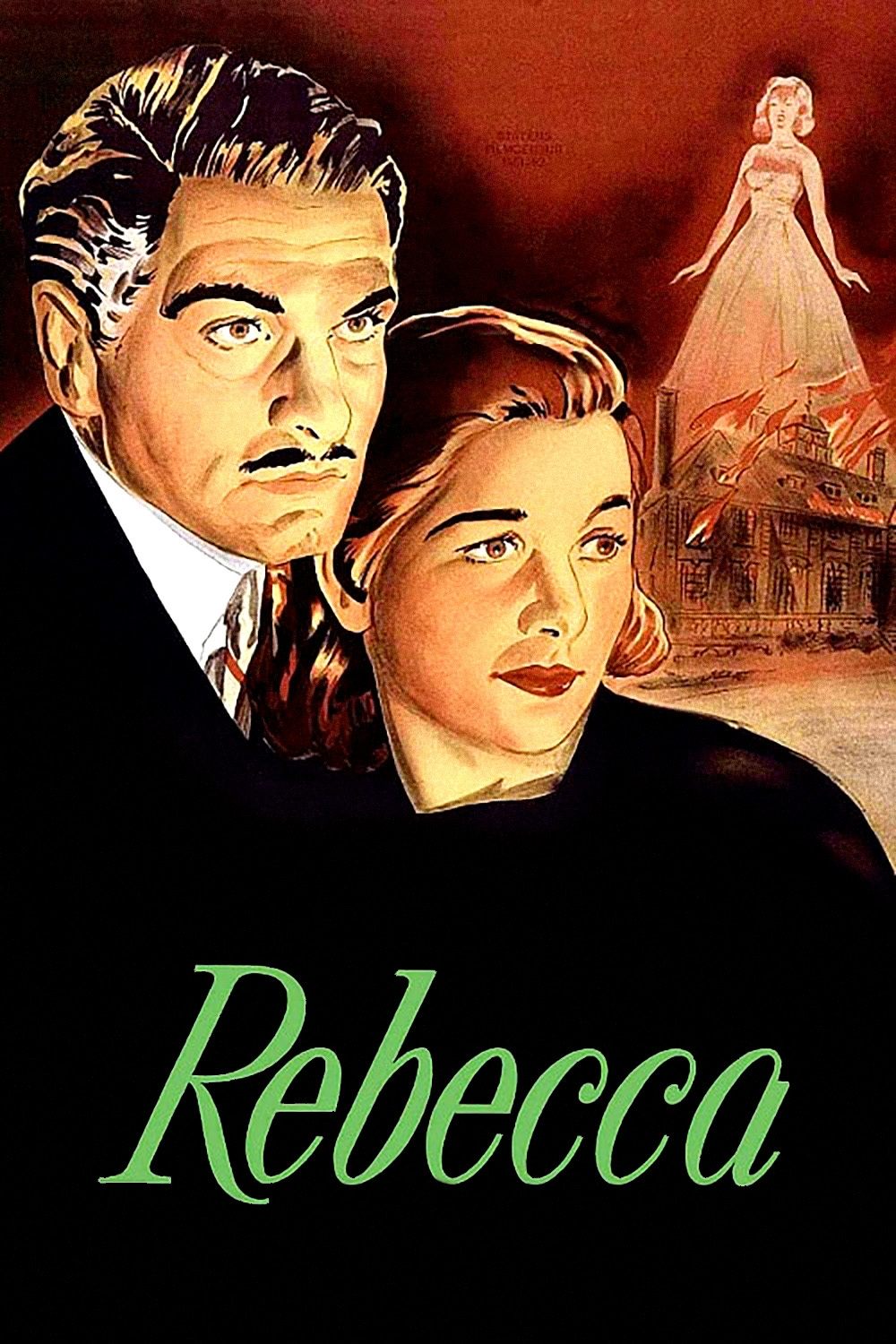
From the very first utterance of “Last night I dreamt I went to Manderley again,” I felt pulled into a hypnotic maze where memory, guilt, and obsession coil around every corridor. Watching Alfred Hitchcock’s Rebecca is like peering through a rain-blurred window into a world where nothing is quite as it seems, and where absence becomes a living, suffocating presence.
The Specter of the Unseen: Rebecca’s Invisible Power
What struck me most profoundly is how Rebecca functions almost entirely in the negative space of the narrative. She is a character who is never once glimpsed alive on screen, yet her presence is more powerful than any living figure in the film. I find this choice by Hitchcock and the original novelist, Daphne du Maurier, absolutely fascinating. The void Rebecca leaves behind is filled with rumor, imagination, and myth. In my viewing, the true horror of the film is not any act of violence or supernatural visitation, but the way a memory—or more accurately, the idea of a person—can haunt the living more chillingly than any specter.
The film’s arc is dominated by the psychological force of Rebecca’s absence. The unnamed second Mrs. de Winter—never given a first name herself—becomes a vessel, haunted and defined by her predecessor. She is yoked to Rebecca’s legend, her style, her grace, and, perhaps most hauntingly, her secrets. Every glance, every whispered conversation, every carefully preserved object in Manderley’s halls seem to conspire against the newcomer’s sense of self. I can sense how Hitchcock builds the entire narrative as a ghost story without a ghost, where the true terror is existential: the fear of erasure by another’s memory.
Manderley: The Architecture of Unease
Hitchcock’s approach to Manderley itself is key to understanding the film’s psychological labyrinth. When I watch the camera drift through its shadowed hallways, linger on lavish yet cold interiors, or peer into rooms as if spying, I’m struck by how the house is shot like a living character. The estate is both fortress and prison, as much a manifestation of Maxim’s and the second Mrs. de Winter’s anxieties as it is an actual place.
The spaces in Manderley are demarcated by privilege and exclusion: the forbidden West Wing, the grand staircase, Mrs. Danvers’ secretive domain. I find the set design and cinematography work in tandem to create a sense that the past is physically embedded in the walls and objects. The camera often dwarfs the characters, emphasizing their powerlessness and the oppressiveness of tradition and expectation. To me, Manderley encapsulates the psychological repression and social rigidity that define the world of the movie—the estate is a vault for secrets and a stage for the performance of identity.
Mrs. Danvers: Devotion, Destruction, and the Elegy of Obsession
Judith Anderson’s portrayal of Mrs. Danvers remains one of the most unsettling performances I have witnessed in classic cinema. What sets her apart is the ambiguous, almost spectral fixation she displays for Rebecca. For me, Mrs. Danvers is not simply a villain; she is a guardian of memory and a high priestess to a lost queen. Her adoration for Rebecca, her meticulous preservation of the late mistress’s room, her efforts to undermine the new Mrs. de Winter, all spring from a place of wounded devotion rather than simple malice.
When Mrs. Danvers manipulates the second Mrs. de Winter into donning a replica of Rebecca’s dress, I interpret this not just as sabotage, but as an act of necromancy—an attempt to resurrect Rebecca’s dominance and humiliate the interloper who threatens her memory. Watching her glide silently through the halls, I felt a profound sense of obsession as both devotion and destruction. Her loyalty blurs into madness, a warning of what happens when the living become caretakers for the dead’s unfinished business.
The Second Mrs. de Winter: The Struggle for Selfhood
The film’s psychological tension is anchored by Joan Fontaine’s incredibly vulnerable portrayal of the second Mrs. de Winter. I was repeatedly moved by how she seems to shrink inside her own skin, perpetually anxious and uncertain. Lacking even a first name, she becomes a cipher—the perfect canvas for projection, both by Rebecca’s survivors and by the audience. I see her journey as an agonizing fight to escape the gravitational pull of Rebecca’s myth and claim her own place in the world.
The film’s central arc is not a romantic awakening but a painful process of individuation. The new Mrs. de Winter must not only win the love of Maxim but also wrest some measure of identity from under the shadow of her predecessor. Her transformation, painfully slow, is not about blossoming into a confident mistress of Manderley, but about surviving a crucible of anxiety, jealousy, and uncertainty. For me, her trembling presence, her tentative steps toward self-assertion, serve as the beating heart of the narrative: the struggle to be seen as oneself, rather than a reflection of another’s absence.
Maxim de Winter: Guilt and the Performance of Masculinity
Laurence Olivier’s Maxim is a fascinating study in emotional repression. I read Maxim as a man haunted not just by the memory of his first wife but by his own role in her demise. His coldness, volatility, and bursts of affection for the new Mrs. de Winter make sense as symptoms of guilt and self-loathing. What I find most interesting is how Maxim’s secrets become both the engine of suspense and an indictment of patriarchal authority. The estate—and indeed, the entire social structure—rests on his power to conceal or reveal the truth.
The revelation of Rebecca’s cruelty and Maxim’s actions on the night of her death reorient the entire film. It is as though the walls of Manderley finally begin to confess. Yet even this confession is marked by ambiguity and moral compromise. I see Hitchcock’s treatment of Maxim as both sympathetic and critical: he is a man unable to escape the consequences of his past, his authority undermined by the very secrets he tries to keep. The performance of masculinity here is revealed as brittle, dependent on the complicity and silence of others.
Costume, Mirrors, and the Rituals of Erasure
One of the most powerful recurring motifs in Rebecca is the use of clothing and reflection. The infamous costume ball scene, for me, is the emotional nadir of the film: the new Mrs. de Winter, unwittingly manipulated by Mrs. Danvers, presents herself in a gown identical to Rebecca’s, only to be met with horror and fury. In that moment, the boundaries between the living and the dead, the present and the past, are violently blurred. The new Mrs. de Winter is literally dressed in the trappings of the woman she can never be, enacting the film’s core tension between selfhood and erasure.
The mirrors scattered throughout Manderley reinforce this tension. I notice that characters are often shot reflected in glass, suggesting fractured identities and the omnipresence of the past. The second Mrs. de Winter, in particular, is frequently shown observing herself, or being observed, as if she is both subject and object in her own life. The rituals of dress, grooming, and presentation become a kind of daily exorcism—a way of fending off the ghost of Rebecca while never quite succeeding.
Morality and the Shifting Sands of Sympathy
As I watched, I found myself repeatedly reevaluating my feelings about Maxim, Mrs. Danvers, and even Rebecca herself. One of the film’s greatest achievements, in my view, is its moral complexity. The narrative dangles sympathy before the audience only to complicate it: Maxim is both a victim and a perpetrator, Rebecca both a martyr and a manipulator, Mrs. Danvers both a villain and a mourner. The absence of easy answers is the film’s enduring strength.
Hitchcock, adapting du Maurier’s ambiguous novel, walks a moral tightrope. The Production Code of the era necessitated alterations to Rebecca’s fate and Maxim’s culpability, but what remains is a world where every character is compromised. I think the film interrogates the price of maintaining appearances and the moral concessions that underpin privilege. No one emerges unscathed or wholly innocent. That uncertainty lingers long after the credits roll, asking viewers to grapple with their own sympathies and judgments.
Fire, Water, and the Ritual of Purification
For all its psychological subtlety, the film erupts into elemental violence at its climax. The destruction of Manderley by fire is, in my analysis, a necessary purge. The oppressiveness of the estate, the weight of unspeakable secrets, the pain of the past—all are devoured by flames. The fire serves as both punishment and liberation. It is the only force strong enough to exorcise Rebecca’s grip, to raze the stage on which so many deceptions have played out.
In contrast, water appears throughout as a symbol of the unconscious—the place where Rebecca’s corpse is discovered, the site of Maxim’s guilt, the domain of memory that cannot be easily tamed. The clash between fire and water at the film’s end suggests to me a ritual confrontation with trauma. Only through destruction can the survivors hope to escape, yet the scars left behind are indelible. The narrative does not offer neat catharsis, only the possibility of survival.
Dreams, Memory, and the Art of Unreliable Narration
The opening lines of the film—spoken in dreamy voiceover—frame the entire story as a memory, a half-remembered nightmare haunted by regret. I came away from Rebecca convinced that memory itself is Hitchcock’s real subject: the way the mind edits, embellishes, and is undone by the past. The haziness of the flashbacks, the ambiguous motivations, the fragmentary revelations all support this reading. The film is not a puzzle to be solved, but a hall of mirrors in which certainty is forever out of reach.
Fontaine’s haunted narration, combined with Hitchcock’s suggestive direction, makes me question every representation in the film. What is real and what is imagined, what is remembered correctly and what is distorted by trauma and desire, remain tantalizingly unclear. The result is a film that feels both concrete and dreamlike, a gothic romance that is as much about the treacherous terrain of the mind as it is about external events.
Recommended Companions for the Journey
If you found yourself absorbed by the psychological shadows and gothic atmosphere of Rebecca, I would recommend seeking out Gaslight (1944) and Jane Eyre (1943). Both films explore similar themes of identity, memory, and the haunting weight of the past, each in their own distinct register.
If you’re curious about how this film was originally perceived or how it compares to similar works of its era, these resources may be helpful.
🎬 Check out today's best-selling movies on Amazon!
View Deals on Amazon