
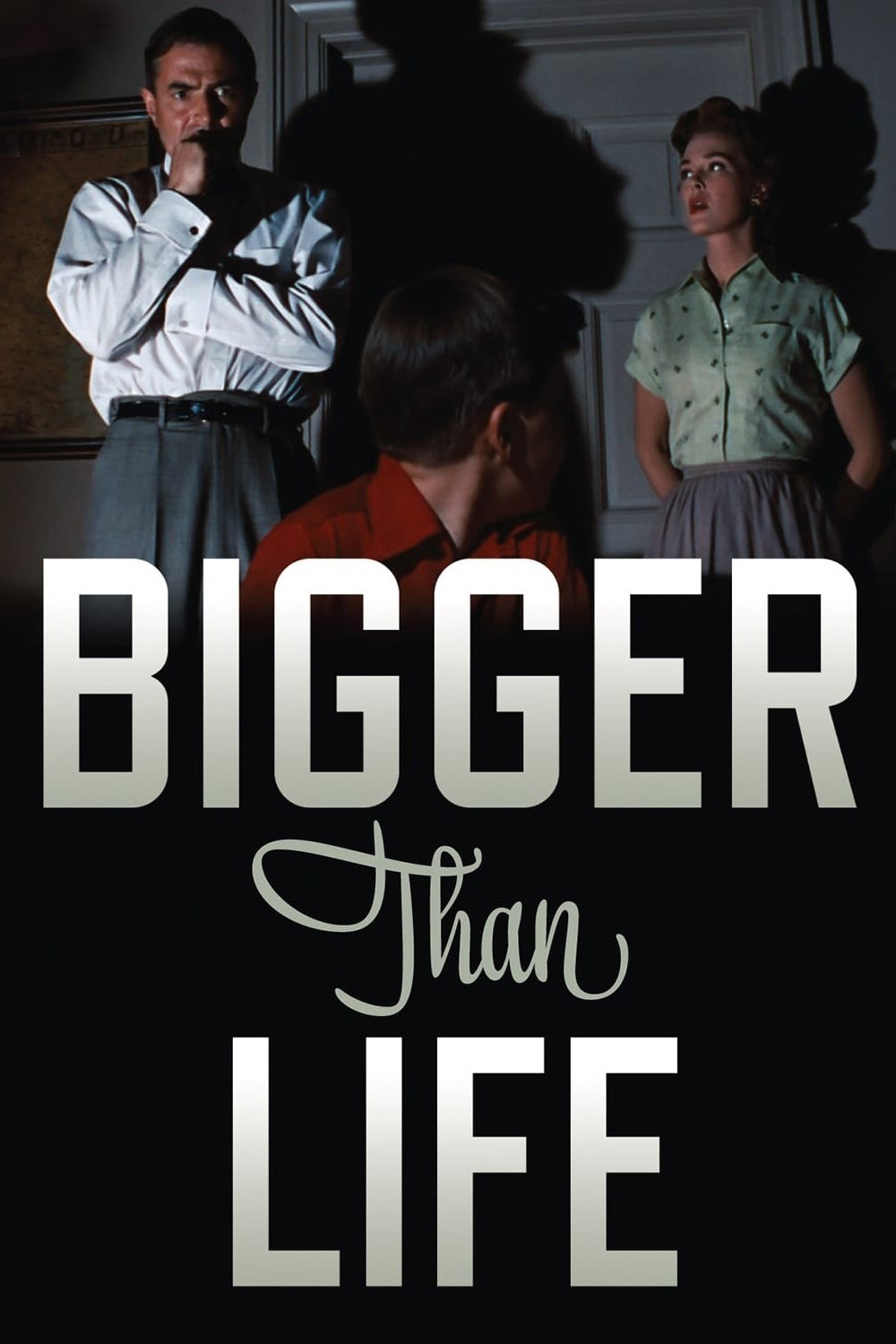
The Monster in the Medicine Cabinet
Watching “Bigger Than Life” for the first time was like having someone suddenly flip on the lights in a room I’d always thought I knew. There’s a horrifying honesty to the way Nicholas Ray tightens his camera around Ed Avery’s family, making their suburban home feel less like a haven and more like a pressure cooker about to blow. What struck me immediately was how the film uses a seemingly straightforward story—a family man’s descent under the influence of cortisone—to strip away the fantasy of postwar American stability, exposing the raw, trembling nerves underneath. It doesn’t whisper its criticism of domestic perfection; it shouts it, in technicolor and in the language of breakdown. As I watched Ed’s transformation, I found myself asking what really lives beneath the surface of that perfectly trimmed lawn, those antiseptic classrooms, that “Father Knows Best” living room. Ray’s answer is as unsettling as it is exhilarating: everything we fear, all at once.
Ugly Truths in a Gleaming Kitchen
The Avery kitchen stands out for me—not just as a set, but as the film’s emotional epicenter. It’s where Ed lectures his son, berates his wife, and paces like a caged animal. The kitchen, always shot with harsh, angular lighting, becomes a stage where the myth of paternal benevolence collapses, and the ugly truth of male authority rears its head. I found myself wincing at every scene where Ed’s voice grew sharper and louder, not because the words were unimaginable, but because they were all too familiar. The kitchen’s sterility makes his outbursts more chilling. This isn’t a gothic mansion or a shadowy alley—this is America’s most sacred domestic space, and it’s here that the promise of “normalcy” is exposed as a brittle, dangerous lie. I can’t help but see Ray’s critique of mid-century masculinity encoded in every clattering dish, every trembling hand. The supposed “provider” becomes the abuser, and in forcing us to watch from such claustrophobic proximity, the film insists we recognize the darkness at the heart of the American dream.
Prescription Pad as Pandora’s Box
What gnaws at me long after the credits roll is the almost gleeful complicity of the medical establishment in Ed’s unraveling. That prescription pad—at first a symbol of hope and progress—quickly reveals itself as a Pandora’s box, unleashing not just a storm of side effects, but a psychic reckoning with the limits of science and faith. “Bigger Than Life” isn’t attacking medicine per se; it’s dissecting the American obsession with solutions, with the idea that every problem has a neat chemical fix. The doctors in the film, framed in white coats and wielding jargon, are never truly empathetic. Their clinical detachment is chilling, and I sense Ray’s deep skepticism about a society that puts trust in chemistry over community. The film’s treatment of cortisone is less about drug hysteria and more about the dangers of believing that our worst impulses—rage, pride, contempt—can be medicated away. In Ed’s spiraling, I see the consequences of a culture that medicates the symptoms and ignores the soul.
Patriarchal Fever Dream
The deeper I dig into “Bigger Than Life,” the more I’m awed by its audacity in exposing the masculine ego. Ed’s mania isn’t just a medical side effect; it’s the logical extension of a system that has always prized male control and paternal authority above all else. Ray does something radical for his time: he refuses to let Ed off the hook. The cortisone may amplify, but it does not invent, the arrogance and violence lying dormant in this man. I keep circling back to the infamous scene where Ed demands that his son perform advanced math beyond his grade level; this is more than a father pushing his child, this is the American fantasy of endless self-improvement turned grotesque. The film reads, to me, like a fever dream in which the unspoken rules of mid-century patriarchy are made literal, monstrous, and inescapable. Watching Ed stalk his own family through their house, I saw less a villain and more a product—a Frankenstein’s monster assembled from cultural ideals, suddenly powerless to restrain the forces that shaped him.
A Home Lit Like a Cage
I can’t talk about “Bigger Than Life” without praising the way Ray and his cinematographer, Joe MacDonald, wield color and space like scalpels. The saturated palette, especially those hellish reds and icy blues, constantly reminded me that this wasn’t reality but a heightened realm where emotion and meaning are painted in broad, sometimes lurid, strokes. The wide CinemaScope frame, meant for landscapes or epics, is perversely used to box the characters in, making the Avery home feel cramped, not grand. There’s a deliberate discomfort to the composition—the walls seem to close in as Ed’s mind unravels, the angles grow odder, the shadows deeper. For me, these visual choices aren’t just stylistic flourishes; they’re active agents in the film’s psychic drama. Every shot reinforces the central anxiety: that beneath the postwar veneer of security and prosperity lurks a terror so vast it can’t be contained by four walls or a prescription bottle. The home, which should be sanctuary, becomes a cage.
The Silent Agony of Lou Avery
I keep returning to the silent endurance of Lou Avery, played with trembling dignity by Barbara Rush. Lou is the real casualty of Ed’s spiral—a woman forced to reconcile her love for her husband with her terror of what he’s become. The film never gives her grand speeches or melodramatic breakdowns. Instead, her suffering is encoded in glances, in the way she grips the back of a chair or stares at her son across the dinner table. That quietness is its own indictment: I see in Lou the cost of a system that expects women to absorb male pain, to normalize violence for the sake of appearances. Her loyalty is both a survival tactic and a tragic flaw, and Ray never lets us look away from the way she is diminished, even erased, by the story unfolding around her. To me, the subtext is unmistakable: the American family, so lauded as the core of social stability, is often held together not by love or respect, but by fear, denial, and the invisible labor of women.
A Schoolteacher’s American Horror Story
The film’s most enduring afterimage, for me, is the transformation of Ed’s role as a schoolteacher. Early scenes depict him as nurturing, beloved by his students and colleagues. Yet as his illness progresses, that identity cracks. The classroom scenes become chilling parables about impossible standards, emotional detachment, and the violence of expectation. When Ed returns to teach after his hospitalization, he stands before the class and delivers a lecture not on knowledge but on the necessity of pain and suffering. This is where “Bigger Than Life” becomes something more than a cautionary tale about drugs or disease—it’s a howl against the way institutions warp individuals, making cruelty seem like rigor and compassion like weakness. I see in Ed’s classroom breakdown a microcosm of postwar anxieties about conformity, authority, and failure—the sense that the very systems meant to nurture us can so easily become engines of destruction.
An American Nightmare, Unmasked
Maybe the most radical thing about “Bigger Than Life,” at least for me, is the way it refuses the solace of easy redemption. The final moments offer the barest glimmer of hope, but nothing is restored; the wounds are still fresh, the family’s future uncertain. The great lie exposed by Ray’s film is the belief that America’s problems—be they medical, familial, or moral—can be solved with a single intervention, a second chance, or a tidy conclusion. I’m haunted by the ambiguity of that ending, by the sense that the Avery family, and by extension the nation, will keep circling the same traumas until they finally break the cycle or shatter entirely. What Ray is really saying, I think, is that every promise has a cost, every cure a side effect, and every dream the potential to become a nightmare.
If This Film Haunts You, Watch These
After the shock and resonance of “Bigger Than Life,” I found myself searching for films that managed to tap into the same vein of domestic anxiety and social critique. Two stand out as essential companions for anyone captivated by Ed Avery’s nightmare: “All That Heaven Allows” (1955) for its lush but quietly subversive portrait of suburban repression, and “The Reckless Moment” (1949) for its razor-sharp look at the dangers lurking in the manicured heart of American family life.
If you’re curious about how this film was originally perceived or how it compares to similar works of its era, these resources may be helpful.
🎬 Check out today's best-selling movies on Amazon!
View Deals on Amazon