
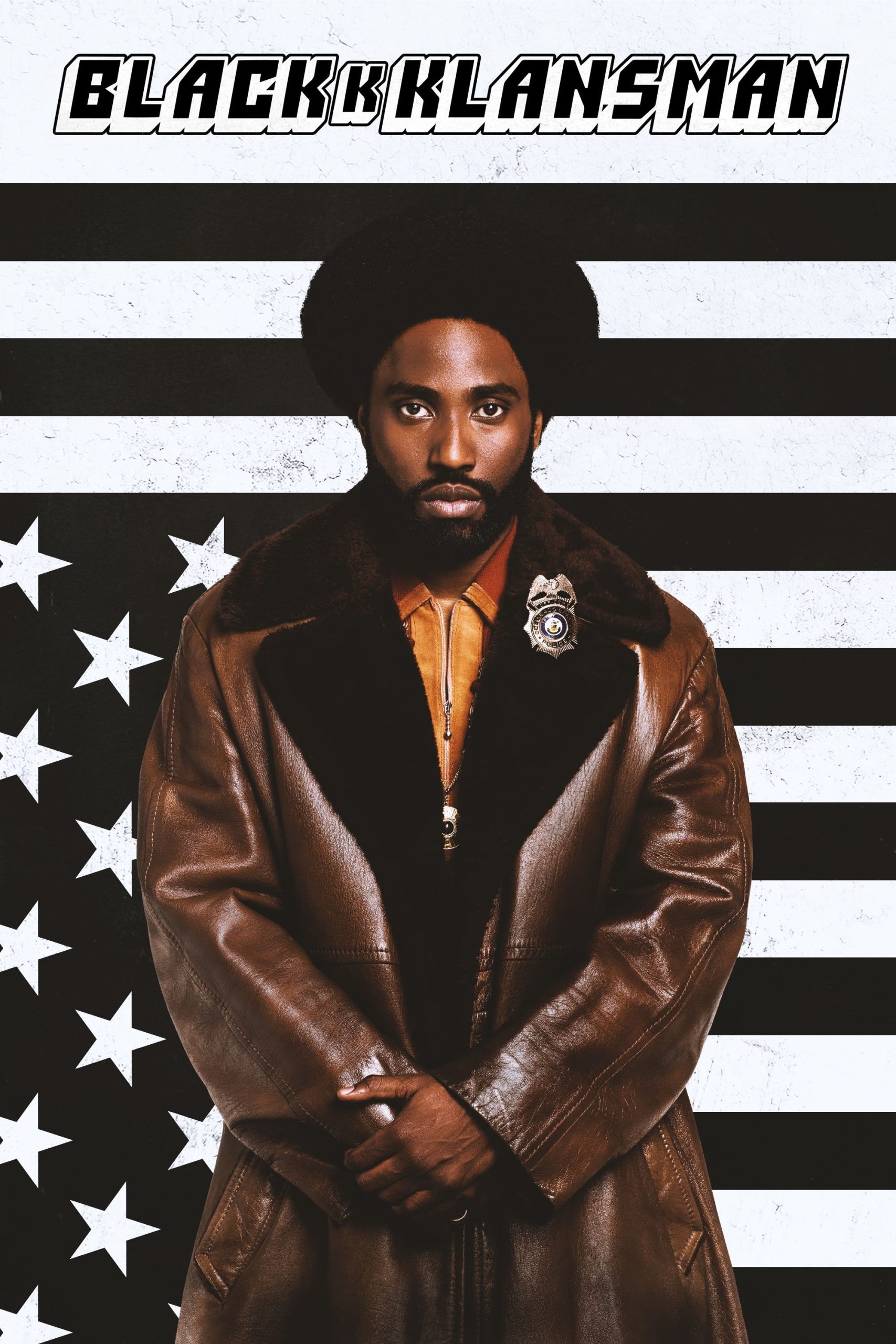
There are certain films that occupy my mind long after the end credits have rolled—not because of their plot twists or feats of technical prowess, but because they force me to confront uncomfortable truths with a sense of urgency that lingers. BlacKkKlansman is one such experience. I remember first hearing about the premise—an African American detective infiltrating the Ku Klux Klan—and expecting a purely satirical take. But what I found was far more layered and discordant. For me, this film is a paradox: both absurd and deeply sobering, almost as if it dares us to laugh at the grotesque ironies of history while keeping us sharply aware that nothing about these stories is merely historical.
What the Film Is About
At its heart, BlacKkKlansman traces the journey of Ron Stallworth, the first Black detective in the Colorado Springs Police Department, as he navigates his way—by telephone and proxy—into the heart of the local Klan chapter. But as much as it revolves around subterfuge and investigation, the film is emotionally anchored in his struggle to reconcile personal identity with the demands of professional performance. Stallworth, played with a careful mix of conviction and restraint by John David Washington, is not simply chasing a case—he is wrestling with what it means to be both inside and outside the systems of American power.
The central conflict pulses with duality: the two-faced nature of allyship and hate, the blurred distinction between theater and reality. While Stallworth and his white colleague Flip Zimmerman (Adam Driver) work together as one composite agent, their collaboration exposes not only the absurdity but also the enduring toxicity of racism in institutional and personal forms. For me, the film succeeds in making palpable a sense of whiplash, toggling between moments of gallows humor and scenes of raw, emotional candor. It’s in this balancing act that I sense what the film is trying to say: that the fight against hate is a labyrinthine, generational struggle—never as straightforward as good versus evil, but rather a continuous dance with moral ambiguity.
Core Themes
Themes of identity, power, and performance run throughout every frame of BlacKkKlansman. The dual nature of Stallworth’s undercover operation serves as a forceful metaphor for how people of color must often “perform” their identity for both acceptance and survival, even within systems supposedly designed to protect them. This resonates with me today, just as it did in 2018, because the demands of code-switching, of straddling different worlds, remain painfully relevant. The film’s release coincided with a period of resurgent white nationalism in America, and its themes cut to the marrow: what does it mean to belong, to resist, to persist within a society structured by race?
The question of power is threaded through every interaction: from the overt hate of the Klan to the subtler, institutional biases Stallworth faces within the police force. Spike Lee never lets us forget that the systems enabling the Klan are mirrored, in part, by those in law enforcement and broader culture. Watching this, I feel a constant tension between progress and regression, hope and cynicism. The film’s humor is not an escape; it’s a defense mechanism against an ever-present, insidious threat. This sense of ever-present danger amplifies the urgency behind the film’s message: it’s not enough to simply spot racism—it must be dismantled, exposed, and relentlessly confronted.
Symbolism & Motifs
BlacKkKlansman is rich with carefully chosen imagery and recurring motifs. The telephone itself becomes more than a device; it’s a symbol of double consciousness and fractured identity. Every time Stallworth uses it to communicate with the Klan, he stretches the boundaries of who he is—invisible yet incredibly exposed. There’s a profound loneliness in this, and I find myself mulling over how technology, intended to connect, often becomes a tool for concealment or for crossing dangerous lines.
Costuming is another persistent motif: the police uniform, the afros at Black Student Union meetings, the white robes of the Klan. Each is a performance in its own right, signaling allegiance or protest, fitting in or standing apart. It’s not just a matter of disguise, but a visual vocabulary that comments on race, power, and the perception of self in a divided society.
Perhaps most haunting is the motif of mirrors and reflections. Several times, characters are quite literally confronted with their own images, forcing a meta-commentary on complicity and self-perception. For me, this visual cue reminds us that the line between perpetrator and bystander, actor and audience, is disturbingly thin.
Key Scenes
A Phone Call with Grand Wizard David Duke
Few moments are as surreal or as telling as Ron Stallworth’s conversational rapport with David Duke, played with chilling self-assurance by Topher Grace. The absurdity of their exchanges—Stallworth’s composed voice contrasted with Duke’s oblivious racism—underscores the deeply ingrained nature of American ignorance. I was riveted by the knife’s-edge tension and comedic undertone, which both amuse and unsettle in equal measure. This scene crystalizes the film’s duality: farce on the surface, tragedy at its core.
The Cross Burning Sequence
I can’t shake the visceral impact of the cross burning scene. Bathed in hellish light, surrounded by hooded figures, the event is presented as both an archaic ritual and a contemporary threat. For me, this is less about spectacle and more about feeling the weight of history pressing in on the present. Spike Lee forces the audience to witness, not to look away—using spectacle to indict us as much as to inform. It’s a reminder that hate isn’t past tense, but burning still, just out of sight.
The Juxtaposed Montage: “Wake Up!”
Near the film’s climax, Lee delivers a bravura sequence intercutting footage of the Klan’s celebration with Harry Belafonte recounting a lynching to activists. This collision of past and present feels almost unbearably direct. I see it as Lee’s challenge: not just to remember, but to bear witness. The montage blurs documentary and fiction, echoing the film’s core message that the legacies of hate are not safely quarantined in history—they bleed into every era, including our own.
Common Interpretations
Many critics have applauded BlacKkKlansman as a nimble satire and a searing commentary on contemporary American racism. The blending of humor and horror, the use of a “true story” to comment on enduring political realities—all these choices are widely acknowledged as masterful strokes. However, some read the film’s conclusion as heavy-handed, arguing that its final montage is too didactic, too on-the-nose.
While I understand this perspective, I find Lee’s willingness to blur the line between fiction and history absolutely necessary. For me, the explicitness is not a flaw, but a kind of moral reckoning—a demand that viewers recognize the continuum between supposedly distant hate and the events playing out in our own neighborhoods. Where some see didacticism, I experience urgency. The discomfort is intentional, and for me, it’s what anchors the film’s relevance.
Films with Similar Themes
- Do the Right Thing – Spike Lee’s own earlier work employs community dynamics and racial tension as a mirror for social unrest, using the city block as microcosm much like BlacKkKlansman uses the police force and the Klan.
- Mississippi Burning – Echoes the themes of institutional racism and the pervasiveness of hatred, depicted through a historical lens of investigative drama within the American South.
- Malcolm X – Also directed by Lee, this film explores the complexities of Black identity and activism, threading biography and cultural history in a manner that resonates with BlacKkKlansman’s interwoven timelines.
- In the Heat of the Night – The tension between outsider and insider experiences within law enforcement and a prejudiced town parallels Stallworth’s dynamic within his department and the broader society.
Final Thoughts: Why BlacKkKlansman Should Still Be Watched
It’s easy to see BlacKkKlansman as just a film about the past, but doing so misses the point entirely. Modern viewers, I believe, must approach it as a reflection of unfinished work—a story whose contours ripple through our headlines and conversations today. Lee’s integration of history and present-day footage strips away any comfortable distance, making clear the dangers of complacency. For me, grappling with these themes deepens not just my understanding of the film, but my awareness of the urgent work that remains outside the theater. There is real value in discomfort: it pushes us to look, listen, and—hopefully—change.
Related Reviews
If you found value in my perspective, you might also enjoy exploring my thoughts on other cinematic landmarks such as Mississippi Burning and Do the Right Thing.
To broaden this interpretation, you may also explore how critics and audiences responded over time.
🎬 Check out today's best-selling movies on Amazon!
View Deals on Amazon