
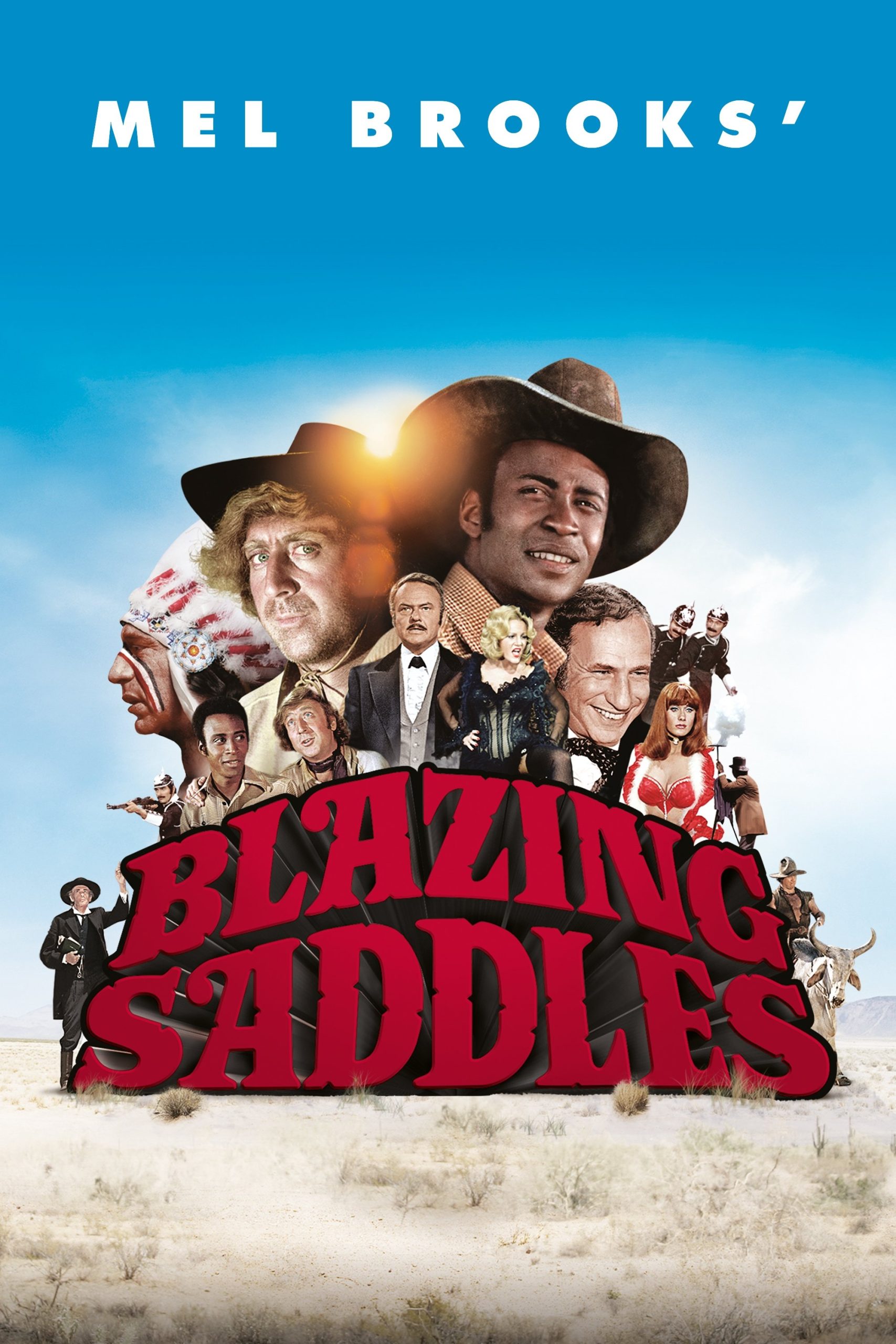
When I first witnessed “Blazing Saddles,” I was sitting amid a group of older relatives whose laughter bordered on raucous cackling. What struck me even more than the barrage of jokes was the film’s audacity—a boldness that felt like it was speaking out of turn, yet somehow saying what so many others refused to articulate. It wasn’t only the wild comedic pace that made me lean in, but the film’s joyful, almost reckless, willingness to skewer sacred cows of cinema, Western mythology, and America itself. My fascination with the film has only grown sharper over time, because what at first appeared to be gags upon gags ultimately revealed itself as a biting, deeply subversive dissection of race, power, and mythmaking in American culture.
What the Film Is About
The emotional center of “Blazing Saddles” lies in its collision between an outsider who must become a hero and a community determined to uphold the boundaries of their small-mindedness. The film’s story orbits around Bart, a Black railroad worker, unexpectedly appointed as sheriff of an all-white Western town teetering on violent self-preservation and looming corruption. His journey from scapegoat to legitimate leader isn’t simply a tale of personal triumph; it’s a test of whether the community—and by extension, the society the film satirizes—can overcome its own fear and tribalism.
The conflict isn’t just between Bart and the town, or between the townsfolk and conniving outsiders; it’s between the manufactured narratives that societies tell themselves and the uncomfortable truths that satire lays bare. What I find so profound is how the film uses the veneer of parody to force audience complicity. No one remains unscathed: not the villains, not the “heroes,” and certainly not those of us watching, who are being asked to laugh, cringe, and recognize ourselves in each punchline. “Blazing Saddles” is, in many ways, an invitation to interrogate the stories we accept as normal, and the prejudices that persist inside even the most beloved traditions.
Core Themes
The central themes of “Blazing Saddles” have never felt more pointed to me than they do in today’s climate. Racism and systemic exclusion are skewered with an irreverent precision rarely seen even in more contemporary satire. The film exposes how power structures conspire to maintain their dominance through spectacle, manipulation, and outright absurdity—all under the guise of tradition or the “American Way.” Watching it now, I am always reminded how comedy can defang, but also amplify, the urgency of a message.
Equally vital is the film’s interrogation of identity, both self-imposed and externally ascribed. Bart’s navigation of his own place in a hostile world, and his ability to find camaraderie with fellow outcasts such as the Waco Kid, reflect not only personal but collective quests for belonging. In 1974, at the tail end of a tumultuous era of civil rights and cultural upheaval, these themes were electric—explosive, even. Today, the same questions persist, perhaps in subtler forms: who gets to define “normal” in America, and who pays the price for it?
Symbolism & Motifs
One of the things I’ve always admired is how “Blazing Saddles” traffics in symbols that are both broad and cunningly specific. The sheriff’s badge, for example, becomes much more than a prop: it’s a locus of legitimacy and hypocrisy. Bart’s badge is supposed to mean authority, yet it is persistently undercut by the prejudice of the people he is meant to protect. Each time the badge appears on screen, it throws the fragile, conditional nature of power into sharp relief.
Railroad tracks thread throughout the film, acting as literal conduits of progress (or exploitation, depending on where you stand). The tracks are also a visual reminder of America’s westward ambitions, and the violence required to realize them. Another recurring motif I love is the breaking of the fourth wall—a cinematic symbol in itself. When the story spills out of its fictional world and into the Warner Bros. studio backlot, it isn’t just a clever stunt: it’s a meta-commentary on the artificiality of the genre and the histories it sanitizes.
Key Scenes
Coffee with the Waco Kid: An Unlikely Alliance
Early in the film, Bart and Jim share coffee in the sheriff’s office, tentatively sizing each other up. In this quiet moment of camaraderie, the film sheds its antic pace and instead meditates on outsider solidarity. I always return to this scene because it’s where the film’s heart crystallizes: in the nuanced, human bond formed amidst chaos and ridicule.
The Town’s Hostile Welcome: Laughter as Armor
When Bart first greets the townspeople and is met with a sea of glares and slurs, the humor of the moment is as sharp as broken glass. This scene weaponizes discomfort; the laughter here is a shield against outright despair. It’s unforgettable both for its shocking frankness and its refusal to let viewers watch passively: the townsfolk’s reaction indicts the audience as much as the characters on screen.
The Final Meta-Meltdown: Breaking the Movie’s Own Spell
The climax—in which the battle spills from the Western town into the “real world” of the movie studio—never fails to electrify me. This is the ultimate act of demystification: Mel Brooks gleefully rips open the seams of genre, narrative, and even the building blocks of Hollywood itself. It’s a flagrant reminder that these stories are made, not born, and so are the prejudices they reinforce.
Common Interpretations
“Blazing Saddles” is frequently viewed by critics as a pioneering satire that dismantles racism using the very tools of slapstick and parody. Many champion its unfiltered irreverence, seeing Mel Brooks as a defender of free speech and a genius of comic subversion. The film’s willingness to use offensive language and stereotype as a satirical weapon is either celebrated as boundary-breaking or criticized as crossing lines of taste.
Personally, I find many of these readings persuasive, but I would add a further layer. What stands out to me isn’t just shock value or verbal pyrotechnics, but how the film destabilizes the viewer’s sense of safety. It isn’t just mocking bigotry; it’s mocking the passivity that allows bigotry to masquerade as the norm. To my mind, it’s less about transgression for its own sake and more about revealing how fragile “normality” really is when you really look at it.
Films with Similar Themes
- Dr. Strangelove or: How I Learned to Stop Worrying and Love the Bomb (1964): Both films lampoon cultural and political institutions, using absurdity to expose the dangers of unchecked authority and groupthink.
- The Producers (1967): Also by Mel Brooks, it interrogates taboos and stereotypes through outrageous comedy, challenging what audiences are willing to tolerate in the name of entertainment.
- Do the Right Thing (1989): While stylistically different, it explores racial tension and the volatile consequences of systemic prejudice within a specific American community.
- McCabe & Mrs. Miller (1971): A revisionist Western that, like Blazing Saddles, deconstructs American mythology—albeit with a more somber, impressionistic tone.
Conclusion
I believe “Blazing Saddles” remains an essential experience for modern viewers—not because every gag has aged without controversy, but because its core provocations are as necessary now as they were in 1974. Approaching the film with eyes open to both its bravery and its flaws allows for a richer understanding of how cultures transmit, warp, and sometimes heal their collective wounds. If we let the film’s unsettled, anarchic energy provoke us, it might force us to question our own boundaries—and perhaps, to laugh our way toward a bit more honesty.
Related Reviews
If you found value in my perspective, you might also enjoy exploring my thoughts on other cinematic landmarks such as “Dr. Strangelove or: How I Learned to Stop Worrying and Love the Bomb” and “The Producers”.
To broaden this interpretation, you may also explore how critics and audiences responded over time.
🎬 Check out today's best-selling movies on Amazon!
View Deals on Amazon