
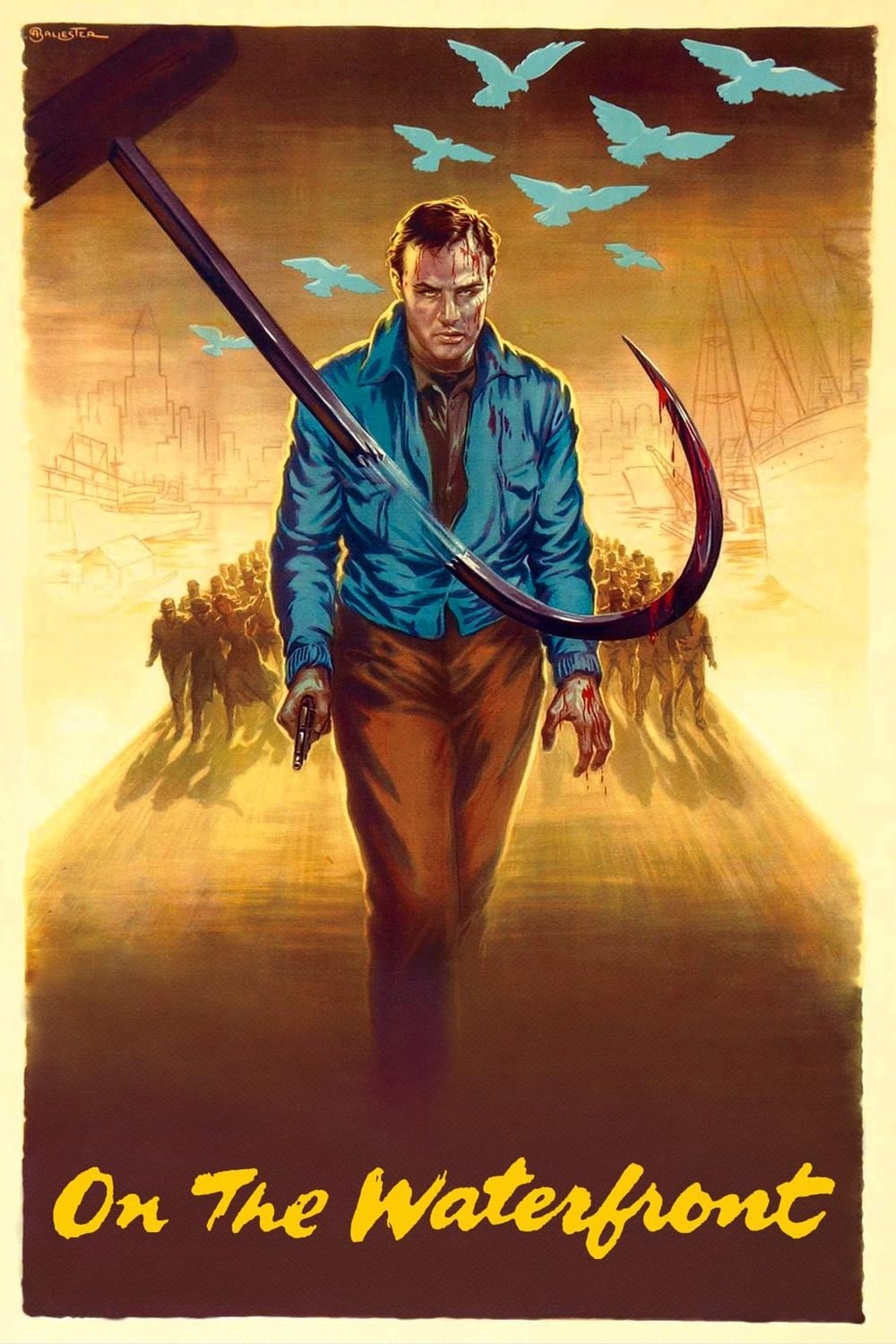
I Coulda Been Somebody: A Personal Reckoning
I can’t watch On the Waterfront without feeling the shiver of its moral ambiguity pressing in from the first frame. For me, this film isn’t just a story of dockworkers and corruption—it’s a brutal meditation on what it means to betray yourself to survive. Every time Marlon Brando’s Terry Malloy shuffles onto screen, I’m reminded of the thousand tiny ways we justify staying silent in the face of wrong, and the price that silence extracts from the soul. The film’s dockyards are bleak battlegrounds, not just for wages but for the ownership of one’s conscience, and I find myself wrestling with the question that haunts the film: Can a man find redemption when all he’s ever known is compromise?
The Weight of Guilt, the Burden of Loyalty
What strikes me hardest about On the Waterfront is how it refuses to let its characters off the hook. The weight of guilt sits heavy on Terry, pressing down on his shoulders as tangibly as the sacks stacked on the docks. What sets this film apart, in my eyes, is the way it renders guilt not as a fleeting emotion but as a persistent, suffocating condition. It’s not just Terry’s guilt for his brother’s death or his complicity in violence, but an inherited loyalty to a corrupt brotherhood that has filled his life with both sustenance and shame. For me, the film’s real brilliance lies in showing how guilt binds us, often more securely than faith or love or hope ever could.
Conscience on the Edge: The Waterfront as No Man’s Land
The docks themselves are more than mere locations; I see them as psychological no man’s lands, spaces where men are stripped of pretense and forced to confront their own complicity. The foghorn blows and the cargo cranes swing, and I feel the tension between the mechanical rhythms of labor and the seismic shifts inside Terry’s heart. The waterfront is liminal, a place where the laws of city or family or God don’t fully apply, and where moral boundaries blur as easily as the skyline in the morning mist. I find myself thinking that this gray zone is where the film locates the true crisis—not in individual acts of violence, but in the slow erosion of personal ethics under collective pressure.
The Unbearable Shame of the Unheard Voice
For me, the most wrenching moments are not the film’s violent outbursts, but the silences—those long, unbearable pauses where Terry’s voice catches in his throat. There’s a physicality to Brando’s performance that makes me wince: his hunched shoulders, his hesitant gaze, his muttered lines. He is a man who has been silenced by his world, by his brother, by his own sense of inadequacy. What the film exposes, in all its rawness, is the way shame can become internalized—how it seeps into every gesture and word until it seems easier to carry the burden of injustice than to risk speaking out and being crushed.
Father Barry and The Gospel of Action
When Karl Malden’s Father Barry enters the frame, the film jolts into a different register. I’ve always felt his quiet, persistent presence was less about religious authority and more about a call to action—the idea that faith, if it’s worth anything, must be lived in the world and not just spoken from the pulpit. Barry’s sermons inside the hold, with the blood still fresh on the dock floor, sound to me not like conventional homilies but as desperate pleas for decency in a system that rewards only silence and complicity. I see Barry as the film’s ethical compass, constantly reminding Terry (and, by extension, the viewer) that there is no absolution without action—that to do nothing is to be complicit.
Edie Doyle and the Disruptive Power of Innocence
Eva Marie Saint’s Edie is often described as a symbol of innocence, but I’ve always seen her as something more disruptive—a kind of unwelcome mirror. Her simple belief in right and wrong, her refusal to accept the easy answers, serves to indict everyone around her. Edie is the film’s conscience, not because she is naïve, but because she is unwilling to accept the status quo that the men around her have come to see as inevitable. Her presence makes Terry’s inertia intolerable, transforming his guilt into action and, ultimately, confession. I relate to her discomfort, her outrage, because who among us hasn’t been told that the world just works a certain way, only to feel the urge to scream that it shouldn’t?
“I Coulda Been a Contender,” and the Myth of Lost Potential
There are lines that echo through the decades, but few hit me like Terry’s lament to his brother Charley in the back seat of that car. “You don’t understand. I coulda had class. I coulda been a contender. I coulda been somebody.” Every time I hear it, I’m struck not just by the disappointment, but by the deep sense of betrayal—of self, of dreams, of what life might have been had Terry not been forced to choose survival over self-respect. That scene plays out like a confession to the universe, and I see in it the film’s clearest meditation on the myth of lost potential—a myth the American dream is built on, and one that is exposed here as both seduction and curse.
The Corrosive Influence of Power and Survival
I find myself returning to how the film explores the corrosiveness of power—not just for the mob bosses like Johnny Friendly, but for every person who chooses the easy, complicit path. There’s something quietly devastating about how friendships and families disintegrate under the pressure of survival. The film insists, with unwavering bleakness, that every act of looking away, every decision to stay quiet, feeds the machinery of corruption just as efficiently as the bosses at the top. This is not just a story of the powerful exploiting the powerless; it’s an anatomy of the little betrayals that make such exploitation possible, again and again.
Testifying on the Waterfront: The Politics of Confession
Testimony matters in this world. Watching Terry finally speak out, I’m always struck by how little comfort or closure it brings. The system is wounded but not destroyed. His confession is a personal victory with a cost, not a triumphant Hollywood ending. The film asks what it means to risk everything for truth, and whether redemption is possible when the world you hope to save is broken beyond repair. The confession is not about cleansing the world, but about salvaging one’s own soul. In this way, On the Waterfront feels less like a fantasy of justice than a reckoning with what real courage looks like—often lonely, frequently punished, rarely rewarded.
The Shadows in the Frame: Visuals as Moral Landscape
I’d be remiss not to mention how the film’s cinematography shapes its meaning for me. The deep shadows, the cold stone, the gray skies—they aren’t just backdrop but moral landscape. Every frame seems etched with a kind of existential dread, as if the city itself is complicit in every crime. Kazan and his cinematographer Boris Kaufman don’t glorify suffering; they render it in stark relief, forcing us to linger on faces, gestures, and moments of doubt. The visual style pulls me into the characters’ internal storms, making it impossible to separate their circumstances from the world they inhabit.
The Price of Speaking Out: Redemption, Not Salvation
There’s a temptation to see the ending as redemptive, but it’s not a happy ending in any conventional sense. Terry stumbles, bloodied and battered, but refuses to stay down. As I watch that final, agonizing walk past the jeering men, I’m reminded that real redemption is rarely clean or complete—it’s a process of dragging oneself, inch by inch, through the muck toward something resembling dignity. The other workers, shaken by his courage, tentatively follow. It’s a moment that, for me, captures the film’s heartbeat: redemption may begin with one person’s pain, but it demands others to step forward too.
Why “On the Waterfront” Still Hurts—and Matters
If I’m honest, what keeps On the Waterfront so alive for me isn’t just its historical context or its classic status. It’s the way the film refuses me easy answers. I sense Kazan working out his own guilt and complicity—his own justifications, maybe, for testifying before the House Un-American Activities Committee. The film’s moral ambiguity, its lack of clear villains and heroes, feels less like a narrative choice and more like an admission: we are all, at some point, trapped between survival and truth, between loyalty and justice, between fear and the desperate hope that our voices might matter.
Two More Journeys Down the Same Wounded Road
For those who want to feel the same sting of moral ambiguity, for those who want to wrestle with questions of conscience, I always suggest All the King’s Men and 12 Angry Men. Each, in its own way, forces us to sit with the discomfort of complicity—and the rare, bruising courage it takes to step outside the machinery and speak up, even if your voice shakes.
If you’re curious about how this film was originally perceived or how it compares to similar works of its era, these resources may be helpful.
🎬 Check out today's best-selling movies on Amazon!
View Deals on Amazon