
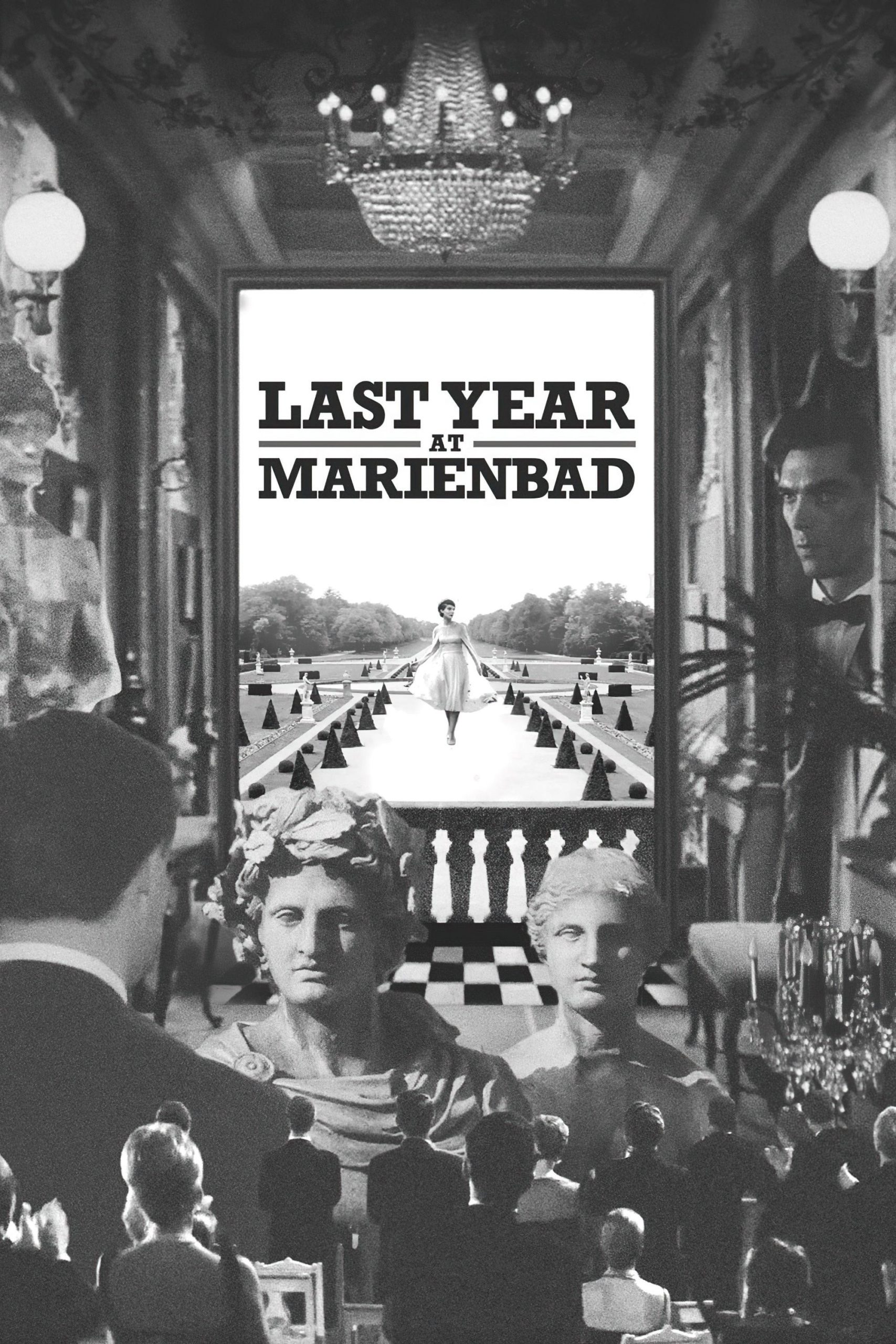
For me, encountering “Last Year at Marienbad” for the first time felt like stumbling onto a dream that didn’t belong to me—one that repeated itself in unfamiliar but seductive patterns. Even now, years later, my mind involuntarily drifts back to its labyrinthine hallways and the echo of unresolved words spoken among silent statues. It’s a rare kind of film that doesn’t simply resist simple interpretation—it quietly dares you to abandon the idea of ever truly “solving” it. I always return, not to decode but to experience the exquisite uncertainty it offers, a sensation as unsettling as it is addictive.
What the Film Is About
At its center, “Last Year at Marienbad” is an emotional fugue—a sustained tension between memory, desire, and denial. The ostensible plot is a minimal one: a man, conventionally named X, approaches a woman, A, at an ornate, seemingly endless hotel, insisting that they met and fell in love last year, and that she promised to leave with him. But she claims to have no recollection of this meeting. The drama is largely internal: questions of truth—whose memories are accurate, whose subjectivity wins out—form the core of the film’s conflict. X is relentless, calm yet obsessive, circling back to their purported romance with mounting urgency, while A floats with trance-like detachment, her uncertainty as pronounced as his conviction.
The film doesn’t present memory as a fixed record but as a territory where longing, doubt, and even manipulation play their parts. Watching these characters is less like witnessing a straightforward conflict and more like eavesdropping on two uneven subconsciouses locked in a struggle for narrative sovereignty. I find the experience exhilarating: every repetition and hesitation, every shift in tone or gesture, becomes charged with the possibility that we might finally tear through the fog. Instead, Marienbad refuses such closure, offering instead a haunting meditation on the impossibility of ever truly knowing another person’s reality—or even our own.
Core Themes
Memory—fragile, unreliable, and manipulable—stands as the film’s most towering theme. When I reflect on what makes this theme so continually resonant, both then and now, it’s the recognition that memory underpins not just identity but all our relationships. In Marienbad’s doubled timelines, endlessly recursive dialogue, and fractured chronology, I see a warning: that clinging to the past, or attempting to reshape someone’s recollection, is a perilous act. This theme, emerging on the heels of postwar Europe, speaks to a collective uncertainty about how to reconcile shared trauma with personal experience. The malaise of characters trapped in this palatial stasis evokes the larger historical anxiety of the early 1960s—when the past loomed too large, and forgetting was nearly as terrifying as remembrance.
The nature of agency—particularly male insistence versus female uncertainty—is another enduring theme. X’s dogged pursuit, his attempts to narrate A into submission, mirror broader questions about the power dynamics of relationships. Even today, the way one person’s certainty can overwrite another’s doubt remains startlingly prescient. Marienbad anticipates contemporary debates about consent, narrative ownership, and truth itself. The film also touches on performance—not just as ritual entertainment, but as the roles we assign each other in private and public space. Restaging an unremembered night is itself a form of performance, raising questions about what is real and what is simply accepted as real through repetition.
In 1961, these themes must have felt thrillingly modern and dangerous. For me, they feel freshly relevant every time I watch—particularly in their rejection of clear answers and their reverence for ambiguity.
Symbolism & Motifs
Every time I revisit Marienbad, I am struck by the way its motifs refuse to settle into easy symbolism—yet feel perpetually loaded with meaning. The hotel itself is a character: its baroque décor, mirrored surfaces, and dizzying corridors speak to endless, inescapable interiority—a literalization of being trapped in one’s own mind or someone else’s story. My favorite motif is the use of statues: the frozen figures in the garden persist as a recurring visual refrain, embodying the paralysis that suffuses every relationship in the film. These statues are both witnesses and stand-ins for the characters’ emotional inertia.
The recurring game, often called Nim or “the matchstick game,” that X plays with the mysterious man M is another compelling symbol. It encapsulates the illogic and circularity of the film’s structure. The fact that X always wins when he wants—except when telling A he will lose—suggests a troubling degree of control, perhaps even over fate or memory itself. For me, these ritualized gestures, whether moving down the infinite corridors or playing the same game repeatedly, reinforce the sense of lives running along grooves laid down by earlier choices (real or imagined).
Finally, Delphine Seyrig’s costume—her decadent gowns, her ethereal appearance—becomes a symbol of timelessness and impossibility. Her image is a seductive mirage: always on the verge of being recognized, always one step removed from certainty. I find the effect entrancing; it’s impossible not to project one’s own longing and confusion onto the characters, swept along by the film’s dream logic.
Key Scenes
The Mirror Maze: Echoes of the Self
There is an astonishing sequence where A stands before a seemingly endless line of mirrors, her reflection fracturing and multiplying into infinity. This image perfectly encapsulates the film’s meditation on the instability of identity and memory—the literal shattering of a unified self into competing versions, none more real than the others. Whenever I watch this scene, I feel briefly disoriented, as though caught between two worlds; it’s a trick of perception that never quite loses its power.
The Matchstick Game: Ritual and Power
The motif of X repeatedly beating M at the game of Nim is not mere ornamentation. As a metaphor for the film’s cyclical, unresolved narrative, these matches become symbolic battlegrounds for control. Each win by X undermines M’s authority and, by extension, A’s ability to resist the reality X is trying to impose. The fact that the game can always be won by the player with the first move is a sly comment on the illusion of choice—an existential echo. For me, the banality of the game, placed against the high drama of personal memory, makes the scene unforgettable.
The Final Corridor: Ambiguity’s Triumph
At the film’s close, A leaves with X through a shadowy corridor, their path dissolving into darkness. This resolution offers neither clarity nor certainty, presenting instead a poetic gesture toward freedom or obliteration—or perhaps both. Each time I watch, I find myself unsure whether the characters are escaping the hotel or stepping deeper into its labyrinth. The ambiguity feels exquisitely earned: a refusal of narrative comfort in favor of lasting enigma.
Common Interpretations
Critical consensus has long championed Marienbad as a paragon of the nouveau roman in cinematic form—an embodiment of literary modernism and a visual illustration of psychological subjectivity. Many compare it to the works of Alain Robbe-Grillet, who wrote the screenplay, and Michel Butor, tracing its fascination with the fungibility of memory and the performative nature of recollection. Some critics, particularly in the 1960s, regarded it as a coded allegory for the Holocaust—an attempt to grapple with trauma through the language of myth and memory.
I understand the appeal of these readings—they certainly deepen appreciation for the film’s complexities—but I find they can be overly academic, even sterile. What moves me most about Marienbad isn’t its intellectual gamesmanship, but its capacity to evoke lived emotional uncertainty. For all its formal experimentation, it is a deeply human story about the impossibility of ever knowing what truly transpired between two people. I don’t need to assign it to a particular historical trauma to feel its power; the existential ache of wanting, doubting, and remembering is enough.
Others claim the film is merely an ornate puzzle, a technical exercise in narrative subversion. I disagree. For me, “Last Year at Marienbad” is not about rational solution, but about learning to embrace ambiguity itself as the only honest state in which to meet another person’s story.
Films with Similar Themes
- “Hiroshima Mon Amour” (1959): Like Marienbad, it threads the mechanics of memory and trauma through an elliptical love story. Both films rest on the unreliability of recollection and the wounds of the past.
- “Eternal Sunshine of the Spotless Mind” (2004): This modern meditation on love, memory, and erasure retools the central questions of Marienbad for a new era, asking whether forgetting offers salvation or loss.
- “Persona” (1966): Ingmar Bergman’s delirious drama mines the instability of identity and performance, presenting reality as something fractured and endlessly elusive.
- “Mulholland Drive” (2001): David Lynch’s film echoes Marienbad’s dream logic, its recursive structures and identity shifts, plunging viewers into a world of unresolved longing and narrative menace.
Conclusion
Coming to “Last Year at Marienbad” today requires openness to uncertainty—and a willingness to be seduced by puzzle pieces that never quite interlock. The real value lies not in deciphering its secrets, but in feeling its moods: the ache of desire unmoored from history, the terror and beauty of ambiguity, the realization that some questions only deepen with time. For any viewer willing to linger in its dim corridors, the film promises not answers, but the exquisite pleasure of wondering.
Related Reviews
If you found value in my perspective, you might also enjoy exploring my thoughts on other cinematic landmarks such as “Hiroshima Mon Amour” and “Persona”.
To broaden this interpretation, you may also explore how critics and audiences responded over time.
🎬 Check out today's best-selling movies on Amazon!
View Deals on Amazon