
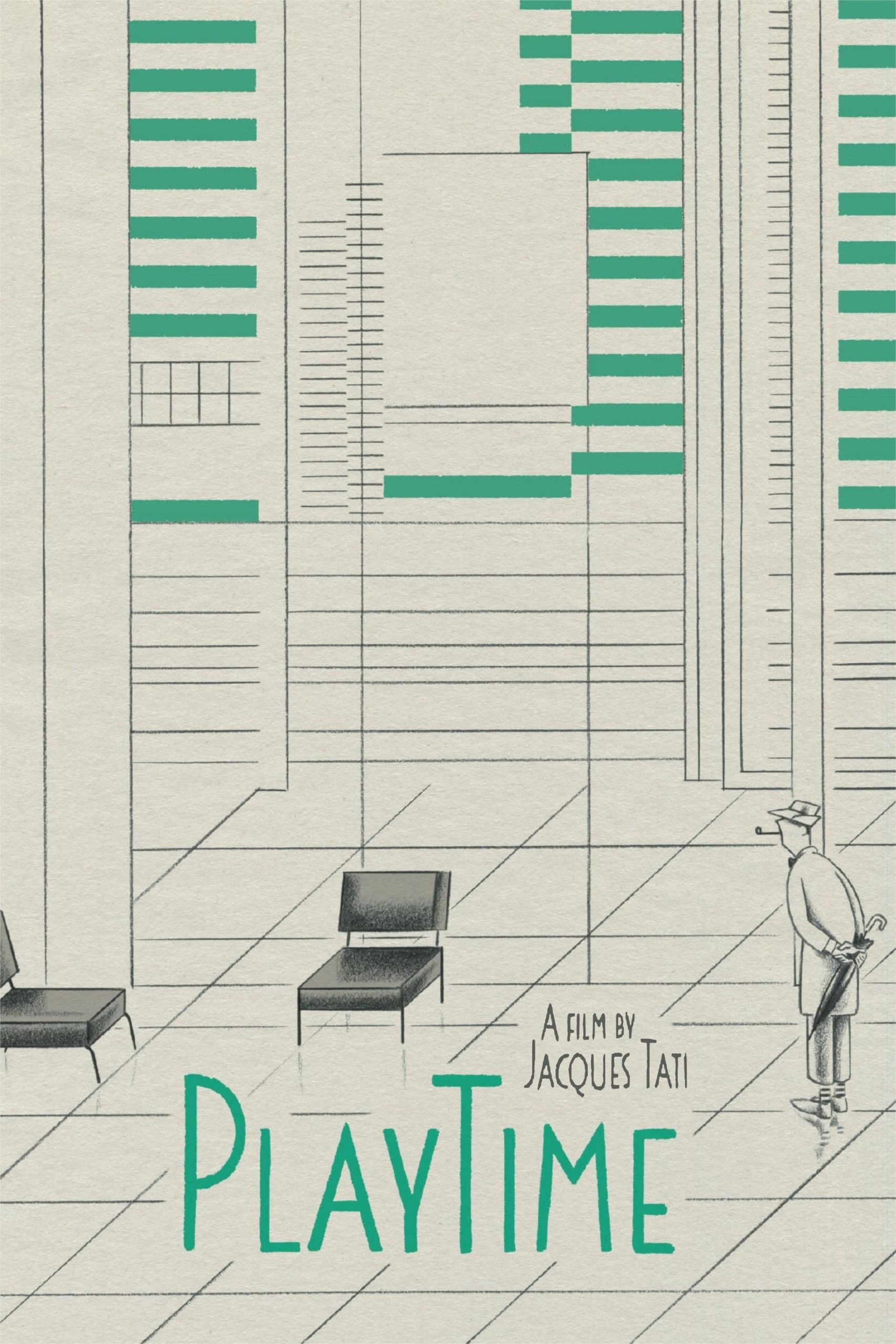
One evening in Paris, I found myself wandering the arrondissements long after the usual dinner hour, drifting along glassy modern walkways and through softly illuminated lobbies. It was well past midnight, yet the city managed to hum gently, its rhythm odd and alluring—never quite restful, never quite wild. In that moment of urban limbo, I realized why Jacques Tati’s PlayTime lingers so uneasily in my mind: it’s a city I have visited in dreams and in real life, simultaneously foreign and achingly familiar, a shadow-world of modernity that reflects both longing and loneliness. I don’t watch Tati’s playful, sprawling vision so much as I wander through it, collecting fragments of myself I didn’t know I’d misplaced.
Disorientation, Encounters, and Urban Drift
At its core, PlayTime is about being lost—not in the thriller sense, but in the quiet, existential way that modern spaces foster. Monsieur Hulot, the film’s gentle, lost wanderer, stumbles through an ultramodern Paris of sleek angles and endless glass, rarely speaking and always slightly out of place. The narrative tiptoes between the comic and tragic as Hulot threads his way through offices, exhibitions, and bustling city squares, never quite able to connect with technology or with the clusters of observers (American tourists as fascinated by Parisian “modernity” as they are alienated by it).
Yet, the emotion that haunts this film is not simple confusion or cultural clash; it is the peculiar melancholy of failed connections. The city’s remarkable efficiency becomes its own barrier, each innovation stripping away small pleasures and encounters. I see Hulot’s journey as an attempt to retrieve those lost moments of human interaction within a world intoxicated by progress. The real conflict in PlayTime is not man versus machine, but the human desire for meaning versus the flattening smoothness of modern life.
Themes in Modernity’s Maze
The alienation of the individual in the mechanical swirl of modern consumer life screams across every frame. Tati’s city is so perfected and sterile that it has no place for idiosyncrasies; every space is interchangeable, from the airport lounge to the office cubicles to the increasingly absurd restaurant. The film’s relentless obsession with glass and mirrors—objects that offer only the illusion of connection—emphasizes how much of contemporary existence is spent observing rather than truly engaging.
In 1967, amidst the postwar boom and the promise (or threat) of technological utopia, these questions felt particularly cutting. Today, in an era where cities sprawl further and digital realities multiply and overlap, the film’s anxiety about the erosion of genuine contact feels prescient. I am especially drawn to the film’s hopefulness, the idea that—despite everything—we can find each other again, if only for fleeting moments.
Glass, Grids, and the Theater of Everyday Life
If there is a signature motif to PlayTime, it is transparency—the sort that doesn’t clarify but clouds. Tati’s use of glass boxes, see-through walls, and endless reflections traps characters in ambiguity, never quite sure what is inside or outside, public or private. These transparent boundaries render everything visible but nothing accessible, a subtle commentary on surveillance and the illusion of openness.
Another recurring motif is the dance of repetition. Automatic doors, humming escalators, and impersonal office cubicles reinforce the sense of an urban choreographed ballet—life reduced to a sequence of mechanical movements. Yet, Tati subverts this order with moments of gentle chaos: a misplaced chair, a rogue sound effect, or a sudden eruption of laughter. It’s in these disruptions, these glimmers of humanity, that I see the film’s most profound critique—technology and design may try to standardize us, but the comic unpredictability of people always breaks through.
Moments That Encapsulate the Film’s Heart
The Glass Labyrinth: Lost in the Modern Gaze
The opening scenes, where Hulot tries to navigate a corporate office, always leave me with a sinking, amused empathy. He loses himself among identical waiting rooms, following a faceless employee through a series of glass-walled corridors that echo back on themselves. Here, the motif of mirrored surfaces and endless corridors makes physical the film’s obsession with alienation and confusion—a Kafkaesque space, but played for gentle, visual comedy rather than horror.
The Expo: Objects for a World Without Touch
Later, Hulot and a group of American tourists traverse a trade exposition of “ultramodern” household products—silent doors, noiseless brooms, and other marvels. Everything is meant to streamline life, but at the cost of tactility and pleasure. Watching the tourists gamely interact with the displays, walled off by language and custom, I feel both the exuberance and absurdity of postwar consumerism. The laugh is never cruel; Tati finds poignancy in the ways people try to bridge the gap with curiosity and kindness, even as their efforts are rebuffed by the environment itself.
The Royal Garden: Dinner Disintegrates into Humanity
No sequence celebrates chaos quite like the film’s second hour, set in a brand-new, malfunctioning restaurant. Design fails, machines collapse, and the guests—released from the tyranny of smooth modernity—finally begin to connect, laugh, and dance. The restaurant, so rigid and anxious at first, transforms into a carnival of warmth. It’s here that I believe the film’s argument is most eloquent: the unplanned, communal, even disruptive aspects of human interaction are what give life meaning. For me, no critic’s analysis has ever surpassed the visceral joy I feel as former strangers come to life among the ruins of self-conscious design.
Reflections and Re-interpretations
Many critics hail PlayTime as a satire of modernism and an elegy for “Old Paris”, reading it as a lament for a city made generic by technology. I see their point—Tati’s Paris is everywhere and nowhere, its landmarks sporadically glimpsed only as reflections on glass doors. The reading of Hulot as a kind of gentle ghost, wandering through the ruins of a vanished sensibility, is compelling and has resonance.
But for me, the film is less about nostalgia and more about potential. I disagree with the purely pessimistic view: Tati’s optimism is encoded in the very sequences where order collapses and people finally see each other as more than silhouettes behind frosted glass. The final movement of the film, with its traffic roundabouts transformed into an accidental carousel, offers not just resignation but a tentative rebirth—a future in which genuine connection, however brief, is always possible.
Cinematic Kindred Spirits
- Brazil (1985) – Both films dissect the absurdity of bureaucratic, over-designed societies, though Gilliam’s vision is darker and more dystopian, while Tati embraces farce and hope.
- Modern Times (1936) – Chaplin’s classic predates PlayTime, but both use comedy and intricate set design to examine how technological progress threatens human dignity and individuality.
- Lost in Translation (2003) – Sofia Coppola’s film, though in a different era and location, similarly explores urban alienation, linguistic barriers, and fleeting connections in sprawling, impersonal environments.
- Her (2013) – Like Tati, Spike Jonze is fascinated by how innovation can isolate us, but also by how human tenacity finds ways to forge meaning and intimacy even in sterile digital worlds.
Embracing the Unfamiliar Today
Modern viewers might at first be unsettled by PlayTime’s lack of conventional plot or dialogue-driven action. But if you yield to its rhythms—watching not for what happens, but for how people move, fail, and finally connect—it becomes a film of endless discoveries. Understanding its themes of alienation, accidental joy, and the redemptive power of chaos adds layers to the experience, allowing us (even in today’s hyperconnected isolation) to recognize the absurdities and wonders of our own cities. I believe PlayTime rewards rewatching because each viewing peels away new, fragile layers of meaning and humor in the anonymous everyday.
Related Reviews
If you found value in my perspective, you might also enjoy exploring my thoughts on other cinematic landmarks such as Modern Times and Brazil.
To broaden this interpretation, you may also explore how critics and audiences responded over time.
🎬 Check out today's best-selling movies on Amazon!
View Deals on Amazon