
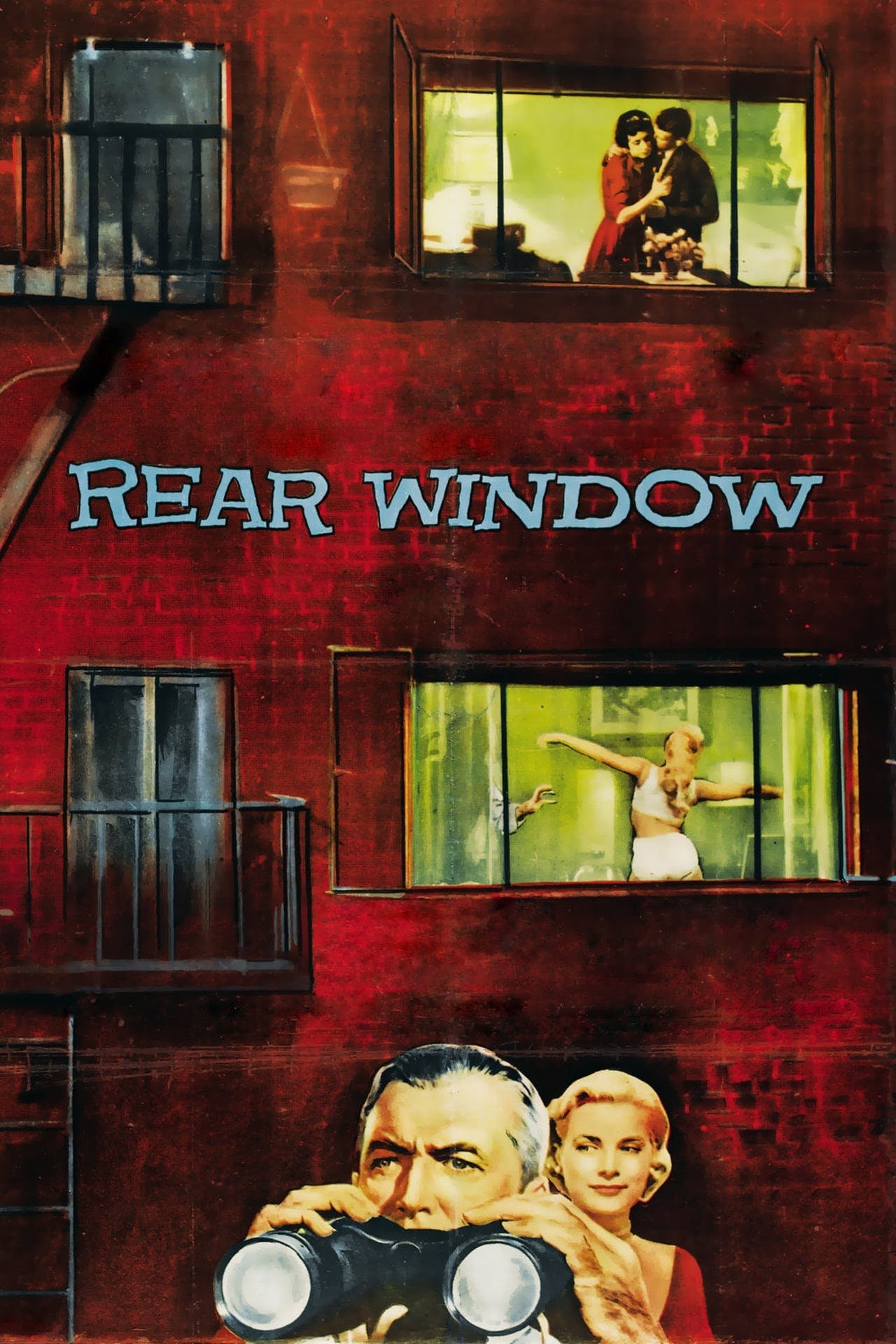
There are films that invite you in; “Rear Window” is not one of them. Instead, it compels you to peer, to pry, to judge from a shadowy distance. From the first time I watched Hitchcock’s 1954 thriller, I was unsettled by how complicit I felt in the act of watching—how delightfully and disturbingly invasive it became. I remember squirming in my seat, torn between an insatiable curiosity and a creeping empathy for the array of unseen, unknowing neighbors framed within L.B. Jefferies’ limited view. This wasn’t merely a murder mystery; it was an invitation to examine my own gaze, to question not just what I was seeing but why I wanted to see it at all. Every time I revisit “Rear Window,” I am drawn anew into its layers: a baroque puzzle box of suspicion, desire, and subtle self-loathing. Hitchcock turns simple apartment windows into confessionals and prison bars—simultaneously offering freedom and enforcing isolation, making me question whose side I am really on.
Through the Panes: The Temptation and Torment of Curiosity
For me, “Rear Window” is an emotional see-saw: the viewer, like the protagonist Jefferies, oscillates between detachment and engagement. At its surface, the film tells the story of a journalist confined by a broken leg, who, with time to kill and an unquenchable sense of boredom, turns his telephoto lens outwards into the courtyard of his New York City apartment complex. The action is limited—at least physically. It’s the psychological escalation that matters. As Jefferies grows obsessed with the peculiar behavior of a particular neighbor, Thorwald, suspicion blooms into obsession until it threatens to unravel not just his sanity but the foundations of trust and intimacy in his relationship with Lisa Fremont, his sophisticated but underestimated girlfriend.
This is not just a whodunit; it’s a how-do-you-know-you-know-it. Hitchcock draws out the agony of perception versus proof. Lisa, at first dismissive, gradually becomes Jefferies’ co-conspirator—a transformation that is almost balletic in its grace and tension. I often find myself drawn in as their dynamic shifts, as love and complicity tangle together. Suspicion here is less about the actual crime and more about how obsessions expose and define us. The very act of observing others, of picking at clues and stringing together narratives, reveals as much about Jefferies—and therefore about us—as it does about any supposed killer next door.
Dark Lenses: Morality, Surveillance, and Gender in a Shifting World
Watching “Rear Window” through the lens of its time—a post-war America brimming with possibility but also saddled with paranoia—adds a new intensity to its central obsessions. In 1954, the anxieties of surveillance, privacy, and changing social roles resonated in every aspect of life: with cold war fears, McCarthyism, and the suburban migration, eyes seemed to be everywhere. Hitchcock channels this unease into a dizzying interplay of private and public, safety and suspicion.
Yet, these core themes refuse to age. When I view “Rear Window” today, in an era oversaturated with digital voyeurism, reality television, and omnipresent cameras, I am struck by how it seems almost prophetic. The impulse to watch, judge, record, and form stories about strangers—often without context or consequence—feels uncomfortably close to home. That’s the dark brilliance of Hitchcock’s design: he holds up a mirror and asks if you really like what you see.
The film’s meditation on gender is equally sharp. Lisa Fremont enters as a figure of grace—a model, a fantasy, someone Jefferies wrongly assumes could never fit into his gritty world of war zones and hard news. But over the course of the film, we watch her outgrow his prejudices. She becomes both a literal accomplice and a metaphorical match: daring, courageous, more agile than Jefferies in every sense. Her arc is as central to the film as the murder plot itself, suggesting that the gaze we turn on each other—and the assumptions we make—limit us more than any broken limb.
Windows Within Windows: Hitchcock’s Visual Metaphors
If I had to pinpoint a single reason “Rear Window” lingers for me, it is its utterly obsessive attention to visual motifs. The film’s most conspicuous motif is, of course, the window itself—an aperture, a barrier, a stage for life to be half-witnessed and half-imagined. The window is both invitation and admonition: every shot is a reminder of the paradox of seeing but not touching, knowing without participating.
Hitchcock populates the courtyard with miniature stories—each apartment a living diorama painted with distinct colors, rhythms, and emotional registers. Miss Torso’s open window is a stage for longing; Miss Lonelyhearts’ drawn curtain, a veil for private despair. The composer’s piano is a recurring aural motif, punctuating the action with moments of hope and disappointment. Each story is a proxy for Jefferies’ own anxieties—a palette of romance, loneliness, ambition, and frustration.
Most compelling, perhaps, is the repeated use of camera lenses, binoculars, and flashbulbs as symbolic extensions of Jefferies’ desire for control and distance. These instruments literally and metaphorically mediate our relationship to danger and empathy, putting the viewer one degree removed—but not immune—from the consequences of curiosity. I often find myself wondering: Does technology really make us less vulnerable, or simply more dangerous in our detachment?
The Domino Effect: Pivotal Moments Under Hitchcock’s Microscope
Lisa Crosses the Threshold
The scene that consistently leaves me breathless is Lisa’s daring entry into Thorwald’s apartment. In this moment, Lisa becomes everything Jefferies is not: mobile, bold, and fully committed. Hitchcock’s slow pan across Jefferies’ anxious face to Lisa’s delicate hands slipping through the window is a masterclass in crosscut suspense. The duality of action and impotence—her risk versus his helplessness—serves as a crystallization of the film’s core anxieties about gendered agency and the costs of knowledge. I always flinch when Lisa waves the murdered wife’s ring as a signal—it’s an act of liberation and a plea for Jefferies to finally see her fully.
Thorwald Confronts the Watcher
For pure terror, nothing rivals the showdown when Thorwald finally confronts Jefferies in his own apartment. The room closes in; the vibrating flashbulb creates a strobe of blindness and fury. Hitchcock turns the tools of looking—Jefferies’ precious camera—into both weapon and shield. Yet, in that claustrophobic confrontation, I am reminded that the consequences of curiosity cannot be indefinitely distanced. The abuser and the abused, the watcher and the watched, ultimately inhabit the same confined space. It is a reckoning—one that is as psychological as it is physical.
Miss Lonelyhearts at the Window
Amidst all the suspense, it’s the quieter thread of Miss Lonelyhearts—the isolated woman who stages imaginary dinners with phantom suitors—that pierces me most deeply. Her attempt at suicide, staged in parallel to the film’s climax, is stopped only by the swell of the composer’s music drifting through the courtyard. The intersecting trajectories of loneliness, hope, and salvation are here distilled into a single, sublime moment. I am always moved by how Hitchcock lingers on her window, suggesting that, for all our watching, the greatest dramas often go unnoticed—reflections, perhaps, of wounds and desires within our own panes of glass.
Prying Eyes: Rethinking the Usual Criticisms
Countless critics have described “Rear Window” as a treatise on voyeurism, and I don’t dispute that it excels as such. Yet, I think the critical focus on this theme sometimes overshadows its subtler achievements. The film is also about empathy—about the limits and necessity of connection. Jefferies’ journey is not merely about exposing a crime but reconnecting, first vicariously and then directly, with the reality beyond himself. The neighbors, in all their variety, function as emotional mirrors; their stories force him—and us—to confront what we lack or fear in our own lives.
While others have rightly noted the film’s meticulous formal construction—the ingenious use of sound and space, the orchestration of long takes—I find myself returning instead to its emotional consequences. What distinguishes “Rear Window” is not just its elegance but its ambiguity: the fact that, by the end, there is no neat moral closure. We have solved a murder but inherited a host of unresolved questions about trust, complicity, and love. If Jefferies and Lisa seem content, I never am; I am left to wrestle with the satisfaction of discovery versus the discomfort of seeing too much.
Some readings critique Jefferies as a passive or unsympathetic protagonist, yet I see his inaction as essential to the film’s meaning. Our own passivity—as viewers, as neighbors, as citizens—raises just as many ethical quandaries. To watch is not to be innocent; sometimes, it is to be indicted in the crimes we witness—or fail to prevent—across the barriers we erect.
Through a Glass Darkly: Cinematic Kindreds in Suspicion and Isolation
- “Blow-Up” (1966) – Michelangelo Antonioni: A meditation on perception, reality, and the dangerous seductions of seeing.
- “The Conversation” (1974) – Francis Ford Coppola: Another chilling exploration of surveillance and paranoia, deeply invested in the ethics of listening and watching.
- “The Lives of Others” (2006) – Florian Henckel von Donnersmarck: A nuanced take on state surveillance and alienation under an authoritarian regime, echoing “Rear Window’s” tension between duty and empathy.
- “Disturbia” (2007) – D.J. Caruso: A modern updating of Hitchcock’s premise, translating the anxieties of constant surveillance into a digital, suburban context.
Looking Back, Watching Now: Enduring Power of a Modern Parable
“Rear Window” never relinquishes its hold on me. Every return visit renews its spell—the tickle of doubt in each shadow, the restless search for answers behind everyday windows. It remains deeply unsettling, endlessly relevant, and visually magnetic. In Hitchcock’s hands, the act of watching becomes a window into ourselves: our cravings, our judgments, our frailties laid bare. As much as I am entertained, I am also reminded to look inward—to question not only what I see but why I seek to see it.
That, ultimately, is why “Rear Window” endures: it is not just about crime or suspense, but about complicity and the uneasy joy of curiosity. In a world ever more obsessed with observation and mediated experience, the questions it raises feel not just fresh but urgent. It is a film best watched—no, experienced—with all shutters open and every defense lowered.
If This Resonated: More Films to Explore
If you found value in my perspective, you may also enjoy my deep dives into these films:
- “Vertigo”
- “Psycho”
To broaden this interpretation, you may also explore how critics and audiences responded over time.
🎬 Check out today's best-selling movies on Amazon!
View Deals on Amazon