
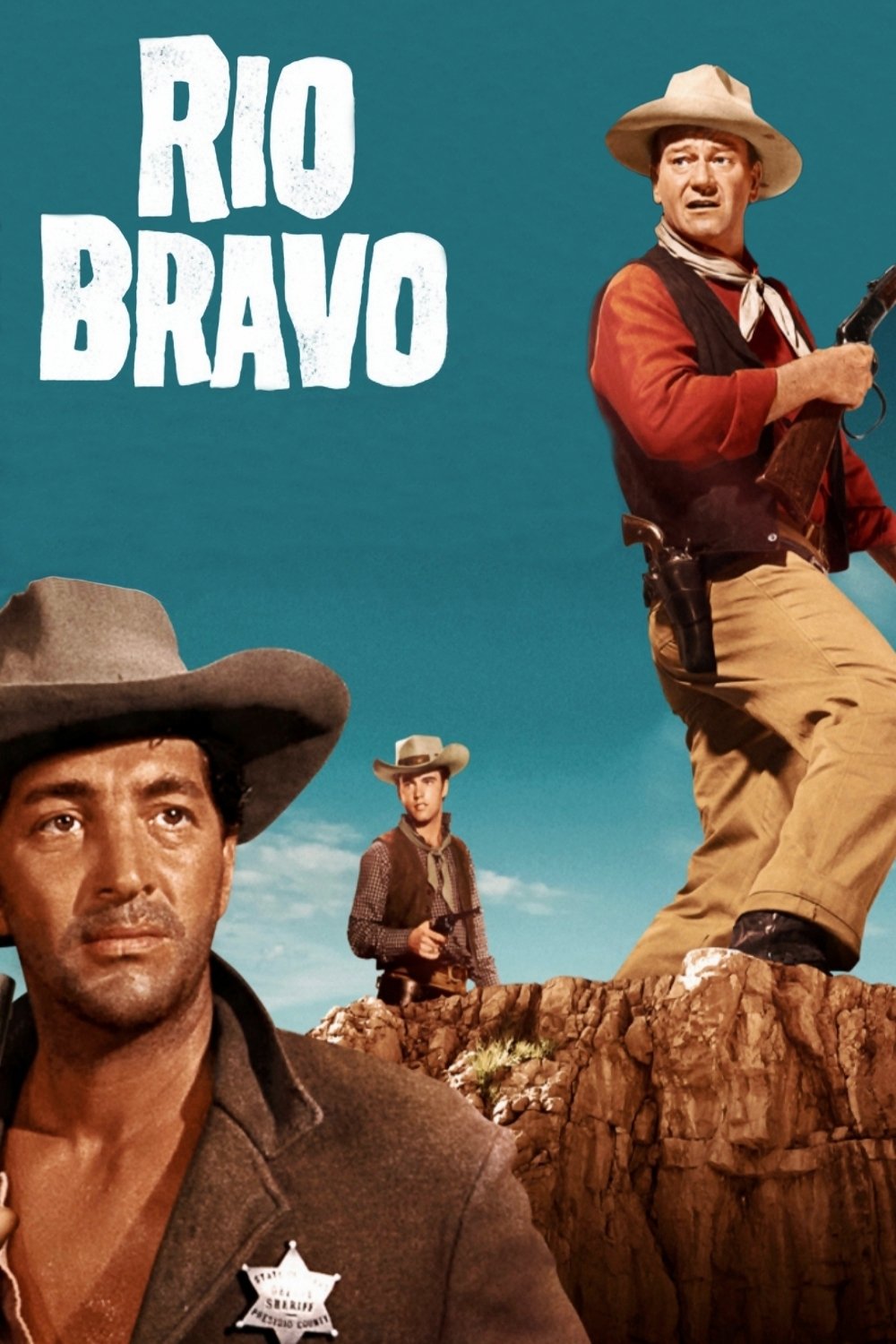
Whenever I revisit “Rio Bravo,” I am met with a tension that feels at once intimate and mythic—an embrace of the Western genre’s grand scale and a defiance of its usual stoicism. This isn’t merely a dusty shootout saga. For me, it’s a chamber drama disguised as a frontier showdown, a film that reverberates with wit, vulnerability, and a kind of unshowy heroism that always makes me question the easy categories of “classic Hollywood” or “old-fashioned masculinity.” Watching John Wayne navigate the claustrophobic tension of the jailhouse, Dean Martin struggle with self-respect in the saloon, and Angie Dickinson upend stereotypes with sidelong glances, I realize how often I return to Rio Bravo not out of nostalgia, but for its perpetual conversation about courage, community, and the quiet test of character.
Desperation Behind the Sheriff’s Door: Rio Bravo’s Ticking Pulse
At its core, “Rio Bravo” is not just another tale of good versus evil, nor does it play exclusively on the broad chords of classic Westerns. Instead, what draws me in is the oppressive, sometimes suffocating weight of its central predicament. Nearly all action and emotion are funneled into the siege-like atmosphere created when Sheriff John T. Chance (John Wayne) arrests Joe Burdette, invites the wrath of the ruthless Nathan Burdette, and must wait—night after night—for the slow grind of justice in a town that grows more dangerous by the hour.
Emotionally, Rio Bravo is a high-wire act. Instead of assembling a posse, Chance finds himself with only two true friends: the drunken Dude (Dean Martin) and the aged Stumpy (Walter Brennan). The trio confronts an external army and also, far more challengingly, their own limitations and doubts. I find myself riveted by how these men’s fears and vulnerabilities are never swept aside—they are the actual wellsprings of tension. The film’s pace invites us to marinate in that anxiety. We barely leave the jail for much of its runtime, so that every rattle at the door, every face glimpsed through a window, every drawn-out silence becomes a test of collective nerve and individual strength.
What elevates “Rio Bravo” from typical genre escapism is not just the slow, gathering storm of violence but the emotional journeys limned within the grand standoff. Chance’s pride, Dude’s struggle with addiction and self-worth, Stumpy’s desperate loyalty, and Feathers’ (Angie Dickinson) insistence on autonomy—all become entangled in a web far more personal than simply protecting a prisoner. The external siege, for me, only amplifies the internal sieges each character must overcome.
Loyalty, Redemption, and the Quiet Power of Community
When I consider the abiding themes of “Rio Bravo,” what emerges most clearly is the insistence on integrity and communal responsibility. By 1959, America was already beginning to languish in Cold War paranoia and the first stirrings of the counterculture. Many read “Rio Bravo”—especially in contrast to 1952’s “High Noon”—as a riposte to perceived collective cowardice; Howard Hawks and John Wayne insisted on the sheriff and his friends holding their ground, not running for help or public consensus. But I see something subtler and more relevant: a lonely, battered attempt to hold fast to principle when the easy route would be surrender or cynicism.
This makes the film’s theme of redemption through friendship and mutual reliance resonate beyond its era. I find it meaningful that Rio Bravo’s central men are not idealized icons, but people with failings—performed not with melodrama, but with a laconic tenderness. Dude’s alcoholism isn’t sanitized or used purely for suspense. Instead, his ongoing struggle becomes a barometer for the film’s faith in redemption. His journey is only possible, I feel, because others stand with him without shaming or abandoning him; the jail becomes a crucible not just for justice, but for growth through solidarity.
For me, another striking theme is the position of women, especially through Feathers’ character. In an era where most Westerns pushed women to the margins, Dickinson’s Feathers is both fully present and fully herself: capable, witty, refusing to bow to outside judgments or confine herself to serving as a simple love interest. Her tenacity and sharp dialogue challenge both the film’s men and its viewers, updating the Western’s mythos for a world that, even in 1959, was growing less tolerant of tired types. Watching today, I’m struck by how her presence feels both radical for its time and still sharply relevant as a rebuke to one-dimensional genre roles.
Sheriff’s Badge, Red Vest, and the Echoes in the Jailhouse Corridor
I often find myself returning to the subtle, recurring motifs that lace “Rio Bravo” together, giving the film its emotional heft beneath the surface-level tension. These motifs—Howard Hawks’ patiently observed details—linger with me long after the credits roll.
First, there is the sheriff’s badge itself—less a symbol of power, more one of burden. It is handled with a peculiar ambivalence by Chance; I notice he wears it less as an emblem of righteousness and more as a physical reminder of the thin line he walks every hour. This resonates in quieter moments, especially as Chance weighs each decision, quietly drawing on the strength that the badge, and what it symbolizes, requires.
Another recurring symbol, and perhaps my favorite, is Dude’s journey with his hat and the return of his red vest. Early on, we see his humiliation played out in the currency of discarded clothing—a motif that becomes a barometer of his self-respect. The film marks his recovery and redemption through the recovery of these items, which serve as visual shorthand for his internal progress. When Dude regains his red vest, it feels less like a costume change and more like a victory—one all the more meaningful for having been won in small, personal ways rather than grand gestures.
Finally, the jailhouse itself becomes a living motif. Its narrow hallways and barred cells, repeated in scene after scene, evoke both protection and vulnerability. I always sense that the jail is a crucible in this film—a site where the decent have to refine their courage, and where the constant threat of violence, visible just outside the frosted glass, is never far away. These recurring visuals transform the setting into a symbol of moral battleground; the town, the saloon, and even light through the window become extensions of the characters’ internal sieges.
Moments When the West Cracks: Essential Scenes of Rio Bravo
The Saloon Floor and a Dollar in the Spittoon
One of the most excruciating and effective moments of “Rio Bravo” occurs early on, when Dude finds himself searching for a drink in the cracked, dusky saloon. Upon noticing a coin tossed mockingly into the spittoon, he must fight both humiliation and the pull of his addiction. The slow, wordless staging of this scene always gets under my skin—the crowd silent, the camera lingering too long—so that when Chance interrupts and restores Dude’s dignity, the gesture carries more than just professional courtesy. It is, for me, the foundation of the film’s core argument: redemption is possible, but only in the presence of others willing to see your struggle and intervene. This moment sets the emotional stakes and binds Chance and Dude in a pact deeper than the law could command.
Feathers at the Hotel: Rewriting the Rules
Another scene I can’t shake comes amid the chilly light of the town’s hotel, as Feathers faces off with both Chance and the town gossips. In a sequence rich with double meanings and sidelong glances, Feathers refuses to slink away despite suspicion and accusation. Instead, she challenges Chance both intellectually and emotionally, making him question his own isolation (and the ways he keeps others at arm’s length). What’s remarkable is how the scene steers clear of easy romance or melodrama; instead, Hawks and Dickinson craft a give-and-take that feels both modern and emotionally honest. For me, this is the point where Feathers stands out—not just as a strong ‘female character,’ but as a moral center of the film in her own right.
The Dynamite Finale: Frantic Violence in the Night
Finally, the showdown in the last reel—a maelstrom of bullets, burning wagons, and Stumpy’s wild-eyed heroism—carries a relentless, nerve-shredding quality that still feels fresh. When Stumpy lobs dynamite at Burdette’s men to break the siege, it’s not simply an action highlight. It’s the culmination of two hours’ worth of pressure, dread, and tight-knit camaraderie. Every explosion, every shout in the night, is earned in ways few action climaxes are. I can still feel the adrenaline and exhaustion, the sense that every character’s arc converges here—not in grandstanding, but in the hard, collaborative work of surviving the night together.
Reputations and Rethinking the Classic Western
Over time, critics have frequently interpreted “Rio Bravo” as a proud rebuke to “High Noon” and its supposed message of collective cowardice. Many scholars and cinephiles frame it as a defense of rugged individualism: a sheriff who refuses to ask the townsfolk for help, taking on evil with only the loyal and the brave at his side. I can’t deny the historical context—Hawks and Wayne’s open rejection of the earlier film’s tone—but I don’t believe “Rio Bravo” fosters an uncomplicated celebration of individual heroism.
Personally, I see the film as a much more complicated endorsement of pragmatic, reluctant leadership and the necessity of **humble, chosen family**. I find myself compelled not by Chance’s bravado, but by his doubts, his need to lean on others, and his open acknowledgment of weakness (sometimes his own, more often Dude’s). Rather than reveling in the myth of the lone gunfighter, “Rio Bravo” foregrounds the emotional labor of supporting those who have fallen down, of seeking connection in the face of siege. In light of the anxieties of its own era—and of ours—I read “Rio Bravo” as a quietly subversive take on leadership and masculinity.
Where critics sometimes treat the film’s long stretches of banter and music as filler, I see crucial moments where trust is built and tested. The famous duet between Dean Martin and Ricky Nelson, for instance, is often derided as a tonal hiccup, but I find that it roots the film in the physical presence of its characters: tense men finding a moment of shared peace, the lull before chaos. This ability to breathe, to linger, is part of what makes the film feel lived-in and honest to me.
Other Westerns with a Shared Spirit
- High Noon – A study in Western isolation, offering a contrasting outlook on communal courage and anxiety.
- El Dorado – Another Howard Hawks collaboration with John Wayne, exploring similar themes of friendship, redemption, and besieged sheriffs.
- 3:10 to Yuma (1957) – A morally ambiguous tale of standing your ground, rich in tension and character-driven conflict.
- My Darling Clementine – John Ford’s poetic, character-centric approach to the Western, blending contemplation with the burdens of authority.
Enduring Embers: Why Rio Bravo Still Resonates
What remains most potent for me about “Rio Bravo” is how it sets aside the bombast of easy heroics for the harder, quieter work of steadfastness—moral, emotional, and communal. The film’s intricate tapestry of loyalty, isolation, and mutual rescue speaks as urgently now as it did in 1959, a reminder that every siege—literal or existential—requires more than just willingness to fight. It asks for the grace to accept help, to bind one’s fortunes to others, and to recognize the value of even modest victories. Watching it today, I find not only a refreshingly modern Western but a timeless lesson in standing together rather than alone.
If you found value in my perspective, I suggest seeking out “My Darling Clementine” or “3:10 to Yuma” for further insights into Western character studies and the evolution of heroism on the American frontier.
To broaden this interpretation, you may also explore how critics and audiences responded over time.
🎬 Check out today's best-selling movies on Amazon!
View Deals on Amazon