
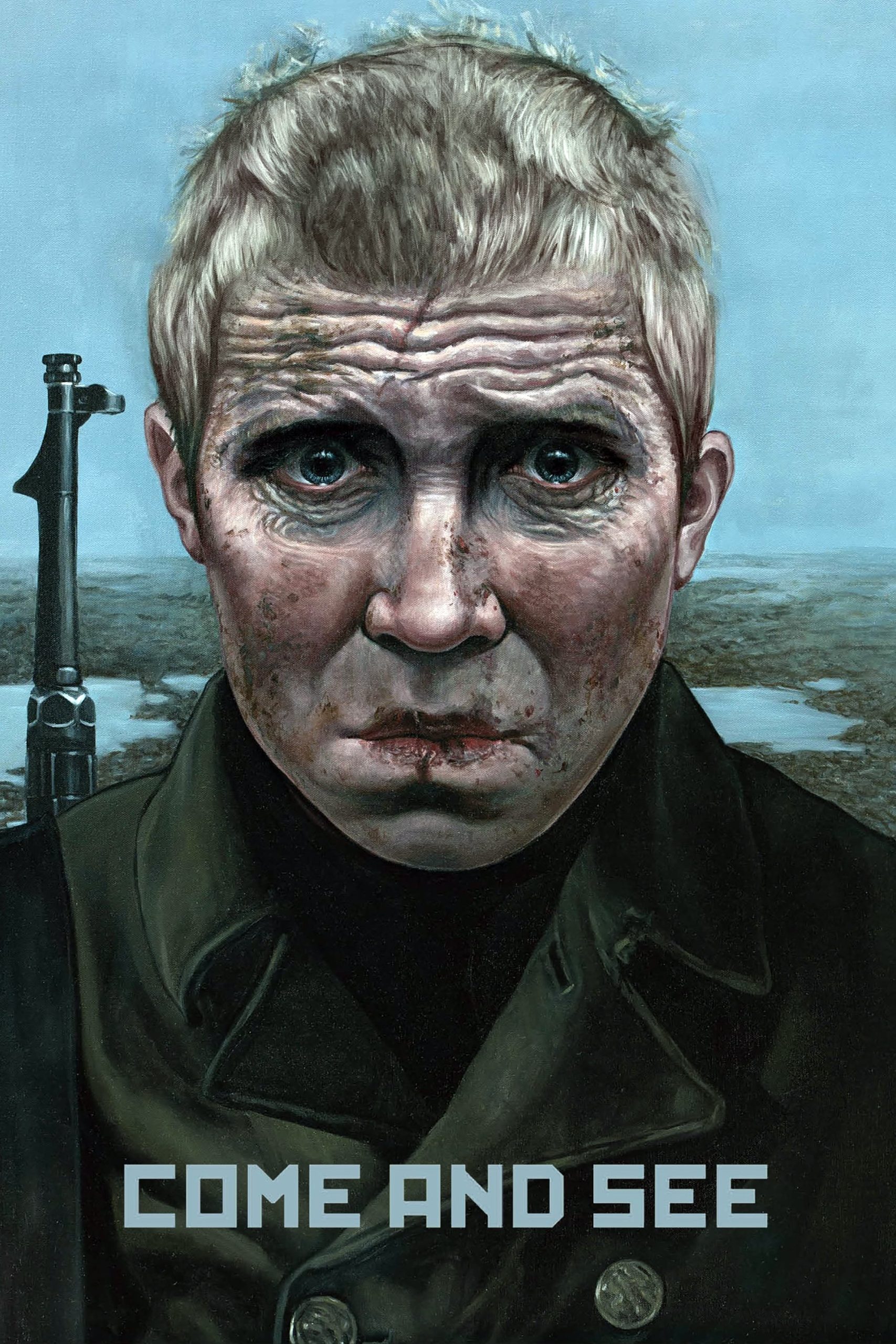
There are films that slip into memory like half-forgotten dreams, then there are those that burrow, refusing to loosen their grip. For me, “Come and See” belongs deeply in the latter category. The first time I watched it, I found myself unable to speak for some time afterward—not because I had nothing to say, but because words felt feeble in the face of what I’d just witnessed. The film’s uncompromising gaze and its willingness to confront horror with unflinching honesty made it more than just a war film in my mind; it became a litmus test for how deeply cinema can penetrate and disturb the soul. I keep returning to it, not to seek entertainment or catharsis, but as a point of reckoning with the contradictions of history, violence, and childhood innocence.
What the Film Is About
If I were to put aside the blunt instrument of summary and instead chase after the feeling the film evokes, I might say “Come and See” is less about the events of war and more about the toxic inheritance that war imposes on the young. Following the journey of Florya, a Belarusian boy swept into the turmoil of Nazi occupation, the film chronicles not just the acts he witnesses but the slow disintegration of his faith in the world. The arc is a devastating one—Florya enters the film brimming with naïve bravado, hoping to find adventure and honor, but as the film strips away every illusion, he is left a shell of a child, a living casualty long before the end credits roll.
For me, the central conflict is almost cosmic in scale, not just man against man, but innocence set against the machinery of annihilation. Every frame seems to underline how war is not the glory of nations but the obliteration of the individual spirit. The narrative doesn’t offer comfort; instead, it places viewers in the direct line of suffering, implicating us through prolonged close-ups and raw, methodical pacing. It’s as if the film tries to make us feel complicit by refusing to look away, pressing us to witness the psychological devastation that history so often tries to obscure.
Core Themes
What resonates at the heart of “Come and See” is a meditation on the destruction of innocence and the inheritance of trauma. War here is not a backdrop, but an active force—one that not only kills but transmutes those who survive into haunted echoes of their former selves. For me, the film’s refusal to allow its hero any solace or redemption is integral to its power. There is a political intent, almost an accusation, in every frame: this is what fascism does, this is what violence makes of our children.
Watching it today, the relevance hasn’t dulled. If anything, the film’s critique of collective violence and the lingering shadow it casts across generations feels even more acute in our era of historical denialism and rising nationalist fervor. In 1985, while the Soviet Union was still a consolidated entity, the film’s release functioned as both a reckoning and a counter-narrative to sanitized war propaganda. Now, I see its themes—dehumanization, complicity, trauma—as warnings not only of the past but of the cycles always threatening to repeat themselves wherever empathy dissolves into hatred.
Symbolism & Motifs
One of the reasons I find “Come and See” so devastating is its command of recurring symbols. Most potent among them is the recurrent use of Florya’s face reflected in a mirror—a device that becomes more harrowing as the film progresses. We literally watch innocence evaporate, his visage aging years within days. These glimpses function almost as accusations; the camera lingers, daring viewers to look away but not allowing it.
The motif of sound—or, often, of traumatic silence—haunts me each time I see the film. The roar of planes, the cacophony of gunfire, and, unexpectedly, the long patches where the world seems to fall utterly still: these sonic choices force a physical unease. For instance, Florya’s partial deafness after an explosion is rendered subjectively, drawing me directly into his confusion and dislocation.
Even the landscape is weaponized by director Elem Klimov. The endless Belarusian bogs and birch forests become symbols of entrapment and historical burial grounds, swallowing joy, hope, and life itself. By permeating every element of the visual field with menace, Klimov ensures that the world of the film feels inescapable, and thus all the more universal.
Key Scenes
The Encounter with the Partisans
Florya’s starry-eyed arrival among the resistance fighters is swiftly undercut. I see this as the moment the film swerves hard away from fantasized heroism. The roughness with which the partisans treat him, the petty squabbles, and the realization that no one is safe or especially brave: these shatter the war story tropes for me. This scene sets the tone for how the film will traffic in disillusionment, not glory.
Wading Through the Mire
There is perhaps no more literal and metaphorical chokehold in the film than the moment Florya and Glasha stagger through the rotting, waterlogged fields. The swamp is not just a physical barrier but a symbol of lost innocence, a descent into a world that will no longer adhere to reason or kindness. The way the camera lingers on every breath and slip, the palpable misery in their bodies, marks a turning point in how I experience the characters—not as actors performing suffering, but as avatars for the very concept of a war-ravaged childhood.
The Atrocity in the Barn
Late in the film comes what I believe to be its blackest pitch: the massacre in the burning barn. Here, Klimov orchestrates the horror without sensationalism, focusing instead on disorienting juxtapositions—faces pressed against wooden slats, screams muffled by smoke, and Florya’s desolate impotence as he witnesses the systematic destruction of his village’s people. To me, this is the nadir—the point of no return, both for the character and for my own faith in comfort within cinema. The psychic ache lingers long after the sequence fades.
Common Interpretations
Many critics have interpreted “Come and See” as a quintessential anti-war film, a Soviet answer to the great question of how to remember trauma. There is frequent praise for how the film exposes atrocity without wallowing in exploitation, employing realism in service of a humanitarian message. This is a view I largely share, but I also feel that some common readings undersell the film’s confrontational ambiguity. Yes, it’s anti-war, but it’s also anti-myth—dismantling not just the glorification of violence but the possibility of finding any redemptive narrative at all.
Some English-language critics have emphasized the film’s use of surrealism—its hallucinatory moments and abrupt editing style. While that’s certainly salient, I find the more impactful aspect is its insistence on dragging psychological horror out of realism itself, letting trauma infect even the most mundane act or glance. It’s not that reality is heightened, but rather, reality itself becomes unbearable. Personally, I read the film as not just a historical document, but a philosophical provocation: a call to witness, to hold ourselves accountable for even the most uncomfortable truths about our nature and our history.
Films with Similar Themes
- The Painted Bird – Like “Come and See,” this film centers on a child’s journey through the wreckage of World War II Europe, grappling with both external and internal violence.
- Grave of the Fireflies – Another devastating portrait of childhood innocence obliterated by war; its animated format belies a similar emotional brutality.
- Idi i smotri (“Come and See” title in other languages) – Returning to Klimov’s own canon, this reinforces the sense of the personal as universal in war cinema.
- Paths of Glory – Kubrick’s take on the futility and moral bankruptcy of war resonates as a precursor in spirit, asking viewers to confront complicity and authority.
Concluding Thoughts: Looking Forward by Looking Backward
No matter how many times I revisit “Come and See,” its unrelenting honesty never loses its force. For modern viewers, I believe the film calls for a kind of active vulnerability—viewing not as spectators but as witnesses. Understanding its themes of innocence destroyed, history remembered through trauma, and the cyclical nature of collective violence makes the experience not just more bearable, but more essential. In stepping into its world, we are challenged to resist the comfort of distance, to see not only the past but our own dangerous present more clearly.
Related Reviews
If you found value in my perspective, you might also enjoy exploring my thoughts on other cinematic landmarks such as “The Painted Bird” and “Paths of Glory”.
To broaden this interpretation, you may also explore how critics and audiences responded over time.
🎬 Check out today's best-selling movies on Amazon!
View Deals on Amazon