
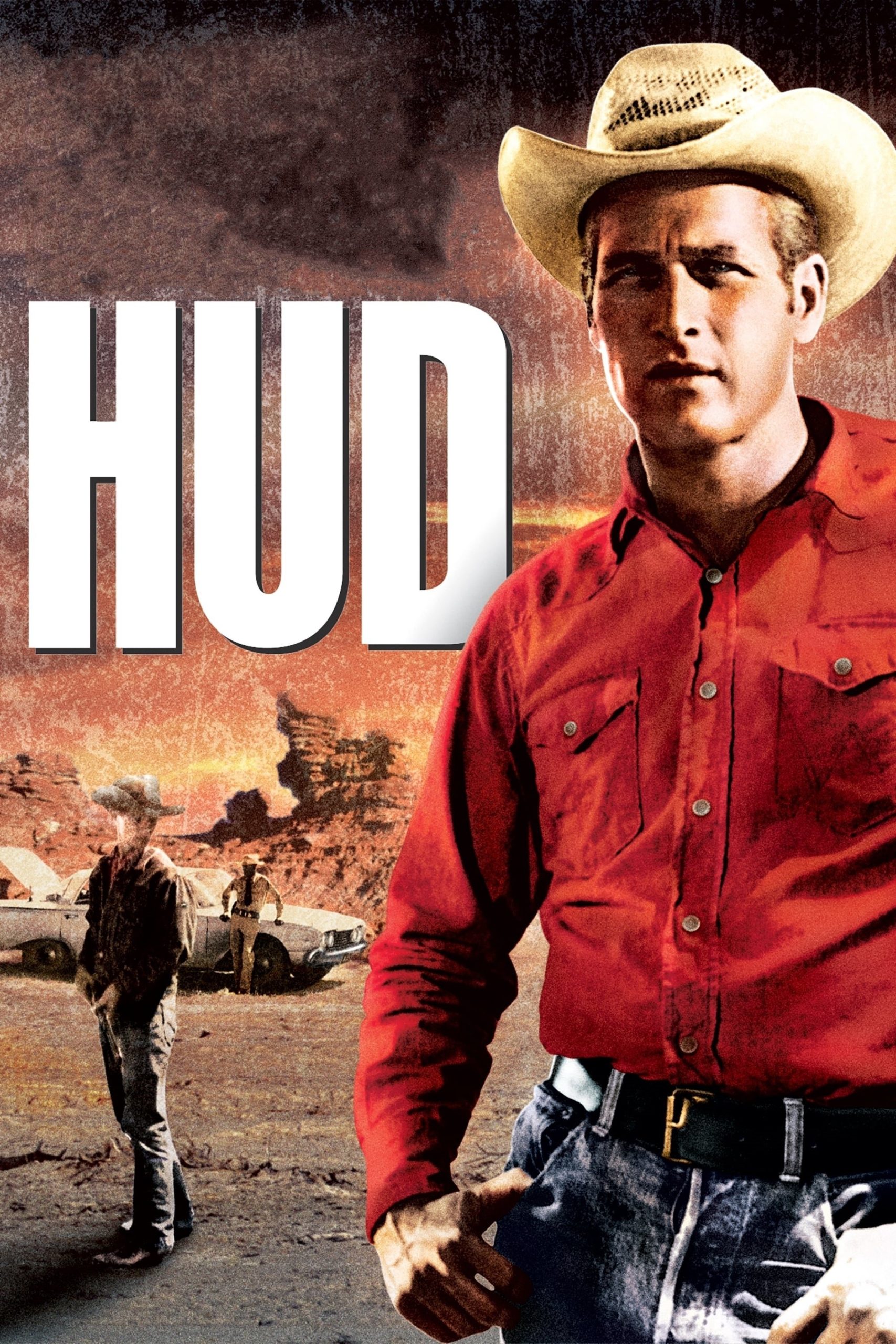
Getting Under Hud’s Dust-Caked Skin
The first time I watched Hud, something about its relentless sunlight and bleak landscape pressed on me like a weight I couldn’t shake off. It’s a film that lives in the spaces between people, in the silences and glares, the vastness of Texas plains echoing with disappointment. Watching Paul Newman swagger through the monochrome world as Hud Bannon, I didn’t just see a character; I felt the film’s accusation, its disappointment with a particular kind of American myth. Hud peels away the layers of what we want to believe about ourselves, and finds only hard, unyielding ground underneath.
Morality in a Landscape of Dust and Sun
I find that Hud is a film obsessed with boundaries—ethical, generational, and personal—and how easily they erode under pressure. The stark black-and-white cinematography doesn’t just evoke the period or the heat; it forces a confrontation with the concept of right and wrong. There’s a mythic sense to the Bannon ranch, as if it’s all that’s left of the Old West, but the film’s moral universe is anything but simple—its characters are caught in shifting sands.
Homer, played by Melvyn Douglas, stands for an uprightness that feels nearly extinct, his values as battered as his aging body. Hud, in contrast, is all appetites—charming, angry, and hollow. Every scene between them pulses with a generational tension that isn’t just about fathers and sons, but about the death of the American ideal of decency. I didn’t find myself cheering for Hud, but I couldn’t look away; his defiance is seductive, even as it’s poisonous. The film confronts me with what happens when moral certainty becomes a relic.
The Lure and Lie of Charisma
Watching Hud, I’m constantly aware of how the camera treats Newman’s character—not as a villain, but as a dangerously compelling force. The film doesn’t condemn Hud so much as it exposes the cost of his charm, the way it corrodes those around him. It’s easy to see why people want to be like Hud: he gets the girl, he talks back, he refuses any authority but his own. The problem is that his rebellion leads nowhere. The film’s greatest subversion is showing how shallow and destructive this kind of individualism can be.
Patricia Neal’s Alma becomes, to me, the perfect lens for reading Hud’s charisma. She sees through him—she wants him, but she doesn’t trust him. The tenderness and wariness in her performance lay bare the way Hud’s brand of masculinity is both magnetic and toxic. I’m left with the aching sense that Hud is a product of a world that rewards style over substance, even as it devours those who can’t play by the old rules.
The Rot at the Heart of the Ranch
The cattle, doomed by disease, serve as the film’s most powerful metaphor. The slow, dreadful process of their destruction isn’t just a plot device. It’s the visible manifestation of decay—moral, familial, and societal—that’s been festering unseen. When Homer chooses to destroy the herd rather than risk spreading the disease, the heartbreak in that decision reflects the impossibility of salvaging a way of life that’s already irreparably damaged.
I can’t help but feel that the film’s bleakness is deliberate—there are no easy redemptions in Hud; there is only acceptance of loss. Even Lonnie, Brandon deWilde’s character, is forced into adulthood not by triumph or wisdom, but by witnessing just how much must be sacrificed to keep a clean conscience. The ranch, once a symbol of continuity and rootedness, is reduced to a haunted shell. The film invites me to mourn not just for the characters, but for the values that have been trampled into the dust.
Alma: Heartbreak and Survival
If there’s a character I keep returning to, it’s Alma. Neal gives her a gravity that balances the male egos swirling around her. She stands as a survivor, scarred but not broken, a testament to resilience in a world that offers little kindness. The brutality of what happens to her in the Bannon house—her violation, literal and spiritual—feels like the film’s most damning statement. Hud’s cruelty isn’t an aberration, but the logical endpoint of unchecked entitlement.
The aftermath of Alma’s assault lingers long after the scene ends. Her choice to leave is not triumphant, nor is it defeat. I see it as an assertion of agency, a refusal to be collateral damage in someone else’s drama. Alma’s quiet dignity exposes the emptiness of Hud’s bravado and the impotence of Homer’s nostalgia. The film doesn’t give her a happy ending, but it gives her the last word—her absence is more powerful than any speech.
Lonnie’s Awakening: No Heroes Left
For me, Lonnie is the audience’s surrogate—young, uncertain, searching for a model to follow. He idolizes Hud at first, then recoils as he witnesses Hud’s moral bankruptcy. Lonnie’s disillusionment is the film’s true coming-of-age story, a recognition that the old codes have failed, but the new ones are deeply suspect.
What makes Lonnie’s evolution so painful is how he’s left stranded between two worlds. Homer’s integrity is admirable but inadequate—there’s no place for him anymore. Hud survives, but at what cost? The film’s answer is that there are no more heroes, only choices, and that growing up means learning to navigate a world where simple answers are extinct.
White Heat, Black Shadows: Cinematic Honesty
James Wong Howe’s cinematography strikes me every time—a shimmering, pitiless glow that refuses to romanticize the land or its people. The unyielding sunlight strips away illusion; the darkness at night feels like a reprieve but never a solution. This isn’t a lush, nostalgic vision of Texas—it’s closer to a moral X-ray. I can’t help but see the connection between the visual style and the film’s meaning: truth here isn’t comforting—it’s harsh, necessary, and deeply unsettling.
The camera lingers on faces, asks us to reckon with pain and regret. The way the film is shot becomes a challenge: can we bear to look, unflinchingly, at a world that has lost its innocence?
The Legacy of Cynicism
What lingers with me after each viewing is a sense of loss—a recognition that Hud is mourning something more profound than a dying ranch. The film is about the failure of the American dream, or at least the version built on rugged, selfish individualism. There’s an aching nostalgia for a time when right and wrong could be clearly defined, but the film never allows such comfort. Hud’s world is one where every value can be negotiated, every relationship is transactional, and sentiment is a liability.
The film’s ending is a masterstroke of ambiguity: Hud wins, in a sense, but it’s a hollow victory, stripped of love, family, and respect. To me, the film is neither a cautionary tale nor a tragedy—it’s a diagnosis, a stark portrait of what happens when we allow cynicism to poison the well. There are no villains or heroes, only survivors and casualties.
Two Personal Recommendations: Kindred Spirits on Film
Whenever I think about films that haunt me the way Hud does, two come to mind:
- The Last Picture Show – For its desolate West Texas setting and its clear-eyed dissection of small-town dreams and disappointments, this film feels like Hud’s spiritual sibling.
- Giant – Another epic about Texas, tradition, and the corrosive power of unchecked ambition. Like Hud, it refuses to offer easy answers.
If you’re curious about how this film was originally perceived or how it compares to similar works of its era, these resources may be helpful.
🎬 Check out today's best-selling movies on Amazon!
View Deals on Amazon