
I Felt the Weight of Corruption in Every Shadow
Watching “Force of Evil” for the first time, I didn’t just see a noir about racketeering—I felt as if I’d been pulled under by the inexorable tide of something rotten, something coiling through the city’s veins. The way Abraham Polonsky frames each shot, the way John Garfield’s Joe Morse moves through his own choices, never let me forget that this isn’t a story about criminals and lawmen, but about the compromises we make for survival and the lines we redraw until nothing’s left of our ideals. From the first harsh gleam of light on the city’s asphalt, I recognized a world where morality and legality no longer align, and every choice comes at the cost of a piece of the soul.
Brotherhood as a Losing Game
It struck me immediately how the relationship between Joe and his older brother Leo forms the pulsing heart of the film’s tragedy. Their dynamic holds more than sibling rivalry or loyalty; it’s an aching metaphor for the impossibility of escape from systemic rot. I watched Joe straddle the line between his ambition and his roots, desperate to save Leo while being inextricably bound to the same criminal engine that’s devouring them both. Joe’s attempts to bring Leo into his world of “legitimate” crime are a cruel paradox, suggesting that, in their universe, even protection is poisoned. I was left with the sense that the closer Joe gets to saving his brother, the more he ensures Leo’s destruction—a moral labyrinth with no exit.
The Gospel According to Numbers
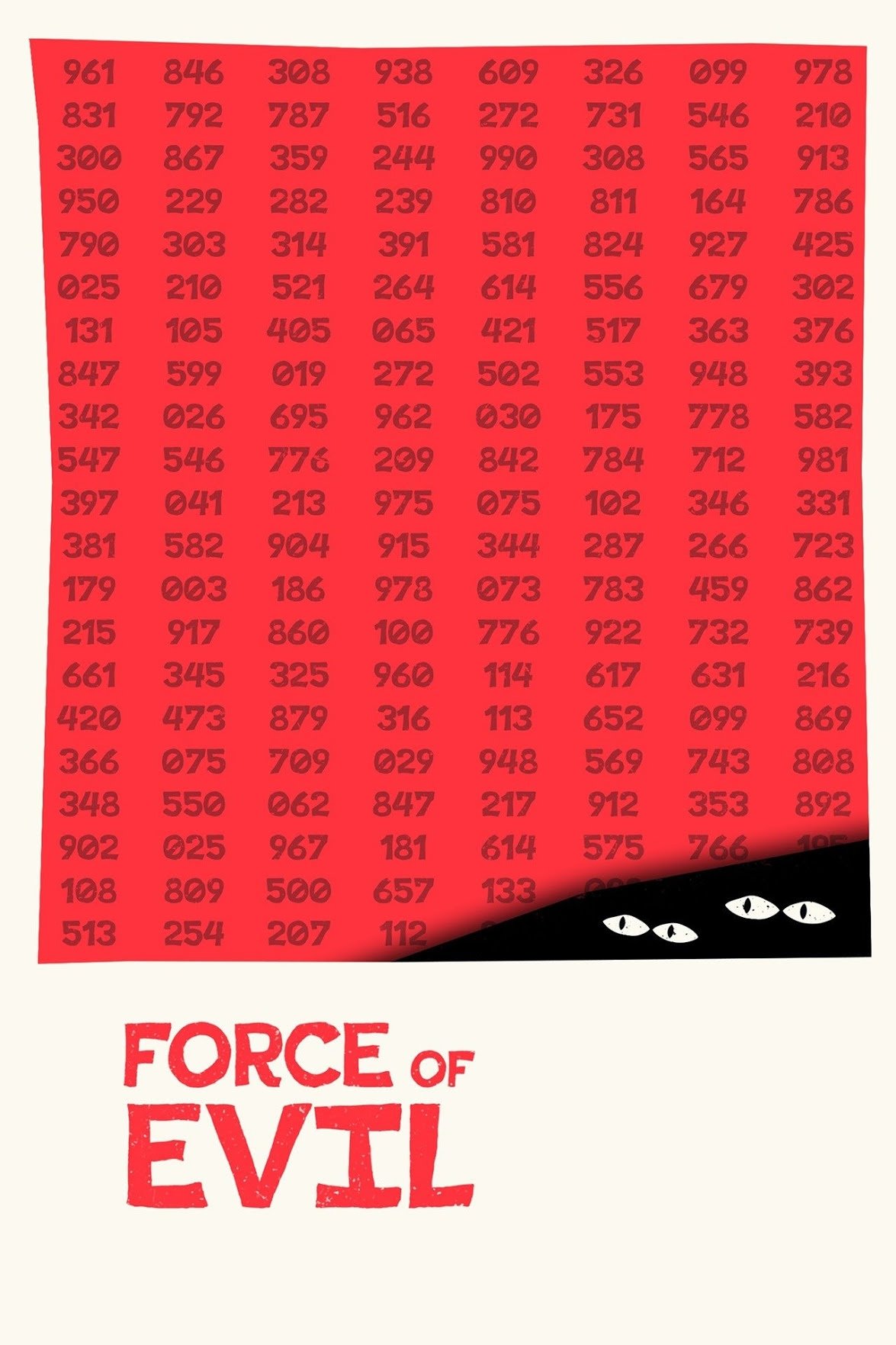
I couldn’t ignore the film’s obsession with numbers, chance, and fate. The numbers racket, on the surface just an illicit lottery, becomes a kind of secular scripture—an arbiter more powerful than any god or judge. I found myself fascinated by the way the characters venerate or curse these random digits: the numbers act as the binding contract of the underworld and the symbol of a city governed by abstract forces no one can fully comprehend or control. When Joe tries to engineer a “perfect” day for the mob, it’s not just a business move—it’s a blasphemous attempt to control destiny, an assertion that man can outwit the caprices of chance. The film, I realized, is less about the hustle and more about our reverence for systems we know are rigged but play anyway, because the alternative is admitting our helplessness.
Money’s Twisted Morality
I’ve rarely encountered a film so unflinching about the perverse logic of money. Every conversation in “Force of Evil” seems to circle back to the question: what will you sacrifice for financial security? Joe’s legalese, with its talk of “consolidation” and “protection,” echoes the language of Wall Street as much as the mob. This deliberate blurring is what unsettled me most. The criminal enterprise is indistinguishable from legitimate business—the difference, the film implies, is only scale and veneer, not essence. I kept finding myself judging Joe harshly, only to realize he’s no different from the bankers and bureaucrats who exploit the same weaknesses in the system. “Force of Evil” doesn’t just indict the underworld; it points an accusing finger at the American dream itself, exposing its dark double.
An Urban Eden, Poisoned
The city in “Force of Evil” is more than a backdrop—it’s an Eden gone rancid. The imposing bridges, the looming skyscrapers, the narrow, sunless streets: all exude a sense of grandeur corrupted by invisible malice. What struck me most were the repeated shots of the river, glimmering yet menacing, cutting through hope like a wound. Polonsky’s vision of New York, for all its noir trappings, interweaves the promise of prosperity with omnipresent threat, suggesting that the city’s vitality is inseparable from its decay. Every time Joe ascends or descends a flight of steps, I feel the weight of aspiration crashing against the reality of descent. The film’s urban iconography isn’t just ornamental—it’s a living, breathing organism, infected by the very ambitions that built it.
The Price of Legitimacy
One of the most haunting threads running through the film is the question of legitimacy: what does it mean to be a “legit” man in a world where the law itself is suspect? Joe’s repeated assurances that he’s seeking security for himself and his brother ring hollow against the backdrop of payoffs and backroom deals. The pursuit of legitimacy becomes a kind of moral laundering, an effort to wash away guilt with the illusion of respectability. Watching Joe, I saw a man who’s traded one set of compromises for another, who’s so intent on escaping the criminal label that he blinds himself to the reality that legitimacy, in this world, is just another racket. The film’s greatest irony is that the closer Joe gets to his version of “success,” the farther he drifts from anything resembling decency.
Language as Weapon and Shield
I was struck by the dialogue’s sharpness—every line feels calculated, at once defensive and predatory. Joe’s speech patterns, slick yet desperate, reveal his need to justify every action, not just to others but to himself. Language in “Force of Evil” isn’t just communication—it’s armor and ammunition, a way to rationalize the irrational and bully the conscience into submission. Listen closely, and you’ll hear the characters talking themselves into circles, seeking coherence in a world that won’t provide it. This endless verbal fencing drives home the film’s bleak wisdom: in a system built on self-interest and self-preservation, truth is the first casualty.
The Descent: Water, Fate, and the Search for Redemption
By the film’s final act, I felt submerged in dread—the literal descent to the river’s edge functioning as both a narrative and spiritual nadir. The river isn’t just where bodies are disposed of; it’s the film’s confessional, the place where self-deception dissolves and only naked guilt remains. Joe’s journey to the water mirrors his gradual unraveling, his final confrontation with loss and complicity. That climactic sequence, with its mournful pacing and haunted silences, left me with the impression that redemption, if it exists, is bought at the price of everything else. The water, for all its potential for cleansing, cannot wash away the consequences of choices made in shadows.
If You Want to Keep Sinking—Two Films for the Same Undertow
I can’t think about “Force of Evil” without recalling the bleak moral universe of “The Asphalt Jungle” and the existential shadows of “Night and the City.” Both films immerse you in underworld economies where the system is as much a villain as any character, and both offer no easy exits. If “Force of Evil” left you pondering the price of integrity when the world is built to break it, these films will keep you wrestling with the same questions—long after the credits fade.
If you’re curious about how this film was originally perceived or how it compares to similar works of its era, these resources may be helpful.
🎬 Check out today's best-selling movies on Amazon!
View Deals on Amazon