
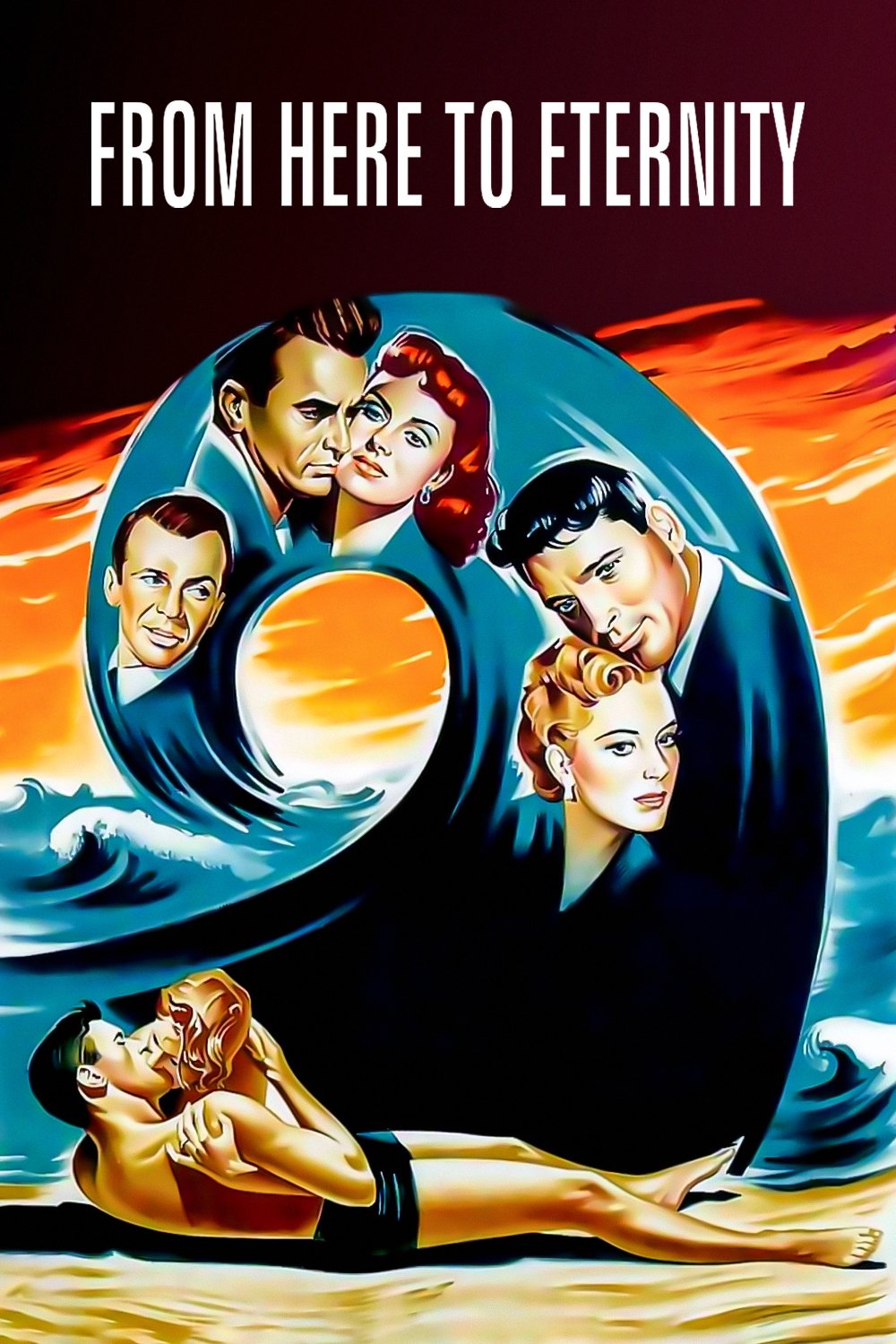
When I first encountered “From Here to Eternity,” I was drawn not by reputation, but by a grainy late-night broadcast. There was something illicit in watching the famous beach scene alone, the surf crashing behind Burt Lancaster and Deborah Kerr. As someone deeply attuned to moments where private yearning collides with the machinery of society, I found myself captivated not by the wartime setting, but by the weight of unspoken desires and the quiet violence of conformity. This film, to me, isn’t just a love story or a military drama—it’s a reckoning with the many ways people are wrenched into shape, or broken, by the places and institutions they inhabit.
The Emotional Battleground of “From Here to Eternity”
“From Here to Eternity” strikes as an aching meditation on isolation within community, the ways every rigid structure—be it army barracks or marriage—can feel like a prison even while promising belonging. I see the film’s heart in Robert E. Lee Prewitt (Montgomery Clift), a man more at war with the invisible rules of his own platoon than with any foreign enemy. His refusal to box again isn’t mere stubbornness—it’s a desperate assertion of selfhood, a final bastion of his dignity amidst relentless pressure to conform. The real fight is not against the Japanese on the eve of Pearl Harbor, but against the suffocating expectations that threaten to erase him.
At the core, the film chases what it means to stand by one’s convictions when the world demands surrender. Prewitt’s relentless integrity grates against his superiors, but what truly haunts me is the ripple effect his defiance has—on Maggio’s fate, on Alma’s dreams, and, most iconically, on the doomed, forbidden romance between Warden and Karen Holmes. This is a film less about love or bravery than about people fraying under the cost of compromise, and about how longing for transcendence—through music, sex, or rebellion—always comes weighted with loss.
The Underpinnings: Why These Themes Still Resonate
To my mind, the essential theme is resistance versus resignation. Every major character faces the choice: do they capitulate to circumstance, or do they insist on authenticity, however destructive? The film’s 1953 release—a period perched between World War II’s aftershocks and the grip of Eisenhower-era societal conformity—makes this conflict especially pointed. In an age defined by latent anxieties about authority, repression, and belonging, “From Here to Eternity” was a profoundly subversive work.
Today, the questions of power, identity, and the cost of belonging feel as urgent as ever. Modern audiences, navigating cultures that still value compliance over complexity, can see themselves in these characters. The army is a microcosm of any system where rules are ways of erasing someone’s edges. I find myself returning to this film whenever I think about what must be sacrificed to be part of something larger—at what point does fitting in mean vanishing entirely? 1953’s audiences needed these questions; so do we.
Visual Echoes: Symbols in Sand and Uniform
One cannot ignore the roiling beach surf, immortalized in the film’s most famous embrace. The waves function as more than backdrop; they signal the impossibility of taming nature, passion, or fate. Watching the lovers, I see them battling both external forces and their own sense of duty—the surf, relentless, washing away their footprints before they can leave a mark. The sea is eros and erasure all at once.
Another constant motif is the military uniform. In every scene, these costumes confine, erase individuality, and broadcast a rank that often belies true worth. When Prewitt plays the bugle—his one accepted outlet—there’s a poignant sense that expression is only safe when filtered through ritual. Music and boxing punctuate the film as competing symbols of selfhood and servitude: Prewitt’s refusal to box is a reclaiming of his essence, just as his bugle-playing is a gesture offered up within the system’s rules.
Bars, doors, and gates frequently hem in the characters, visual signals of their entrapment. Even the mess halls and bedrooms are shot with claustrophobic intimacy, reminding us that in this world, privacy is perilously thin and escape nearly impossible.
Moments That Change Everything
Bodies Colliding in the Surf
The famous beach scene—more than iconic imagery—captures in a few breathless minutes the film’s whole doctrine. I see in Lancaster and Kerr’s embrace not just eroticism, but an exhaustion born of secrecy and frustration. This is less about romantic liberation than about two people grasping for tenderness in an environment built to suffocate it. Their union is brief, their consequences immediate.
Maggio’s Last Stand
Frank Sinatra’s Maggio, swaggering and brash, faces his end with heartbreaking resolve. Sinatra famously won an Oscar for this performance, and what stays with me is the rawness beneath the bravado. Maggio’s death, foreshadowed by every injustice and indignity he suffers, is the real defeat—a casualty of colleagues’ complicity and institutional cruelty. When Maggio breaks, the illusion of brotherhood in the barracks is shattered for good.
Prewitt’s Silent Refusal
There’s a moment, quiet and devastating, when Prewitt stands his ground despite mounting threats and provocations. His insistence on not boxing, even at the cost of friendship and safety, is the film’s ultimate act of resistance. Nothing flashy happens here; it’s all in Clift’s restraint, a performance so tightly wound that it threatens to unravel in every frame. In this defiance I see the stubborn, bruised kernel of humanity that gives the film its lasting power.
Contrasting Critical Readings
Over the years, critics have often focused on “From Here to Eternity” as a frank critique of military rigidity and the damage it inflicts on vulnerable souls. Many treat it as a melodrama about doomed love and war, citing its groundbreaking frankness (for 1953 Hollywood) around adultery, social mobility, and sexual frustration. Some scholars highlight its technical innovations—the shadowy cinematography, the kinetic editing during fight scenes, Zinnemann’s blend of on-location grit and studio gloss.
But for me, the mainstream interpretation feels too neat. The film is less an anti-military parable than a portrait of existential exhaustion. When I watch Prewitt or Warden, I don’t see heroes standing up to power: I see weary souls negotiating survival in a world indifferent to their pain. The spectacle of war, the lure of forbidden romance—these are byproducts of a system designed to subsume personality. My emotional response is not anger at injustice alone, but a melancholic recognition of the ways even our fiercest convictions are worn down.
Works That Walk a Similar Path
- “The Best Years of Our Lives” (1946): Like “From Here to Eternity,” this drama explores the damage done to individuals trying to navigate the rigid codes of postwar America. Both films dissect the human cost of institutions that promise safety and instead demand psychic contortion.
- “A Place in the Sun” (1951): Montgomery Clift again embodies a protagonist crushed by class expectations and emotional repression. The longing and self-sabotage echo Prewitt’s battle within himself and his environment.
- “On the Waterfront” (1954): Another story of masculine pride and institutional failure, this film interrogates the price of ethical integrity when the surrounding culture is corrupt or indifferent—a twin to Prewitt’s lonely stand.
- “Paths of Glory” (1957): Kubrick’s anti-war classic shares with “From Here to Eternity” a fierce skepticism toward military hierarchy and the moral dangers of blind obedience.
Looking Backward to Move Forward
For those drawn to cinema’s exploration of moral ambiguity, “From Here to Eternity” offers endless riches. Watching it today means confronting your own temptations to comply, to fit in, to keep quiet when the stakes feel insurmountable. The film’s thematic density and complex performances make it an enduring mirror—one that asks not just who you’d be in its world, but what you hold on to in your own. Understanding its central struggles transforms the movie into more than just a period piece; it becomes a lens on the ongoing drama of being fully, painfully alive.
Related Reviews
If you found value in my perspective, you might also enjoy exploring my thoughts on other cinematic landmarks such as “On the Waterfront” and “The Best Years of Our Lives”.
To broaden this interpretation, you may also explore how critics and audiences responded over time.
🎬 Check out today's best-selling movies on Amazon!
View Deals on Amazon