
The Unbearable Weight of a Child’s Shadow
The first time I watched “Ivan’s Childhood,” I found myself haunted less by the explosions and battlefield horrors than by the quiet insistence of Ivan’s eyes — those unblinking, grown-old eyes, always searching the darkness for something he could never quite grasp. This film is not simply a war story; it is a requiem for childhood, a meditation on innocence lost and the price of survival in a world gone mad. If you strip away the plot’s surface — a boy working as a Soviet scout behind German lines — what lingers is a psychological maze, one where no exit leads back to light.
Memory as Refuge and Prison
What strikes me most deeply about Tarkovsky’s vision is his use of memory — not as a linear recounting, but as a ravenous force, both sanctuary and snare. The recurring dream sequences are not just stylistic flourishes; they are the true battlegrounds of Ivan’s soul, where the possibility of peace still lives, but only as a ghost. Scenes of Ivan in sunlight, running along a beach or resting beside his mother, are rendered in luminous contrast to the grim, water-logged reality of his waking hours. These visions are not comfort. They mock him with their unattainable simplicity. Tarkovsky suggests that trauma corrupts even the sanctity of memory, leaving Ivan with longing that sharpens into pain.
War’s Most Profound Casualty: The Imagination
Whenever I revisit this film, I am struck anew by the idea that the most devastating casualty of war is not merely the body, but the imagination of the young. Ivan’s actions are preternaturally competent, his resolve hard-edged. Yet, Tarkovsky persistently returns to moments of play and fantasy, reminders of a boyhood that should have been. The film asks: what happens when a child’s imagination, designed to create, is forced to serve destruction? Ivan’s bravery is less a virtue than a wound; it propels him forward, away from the dreams that might have saved him. In the world Tarkovsky conjures, valor is a form of self-obliteration — the ability to turn off, to numb, to act without hope.
Water, Wood, and Ash: The Language of Tarkovsky’s World
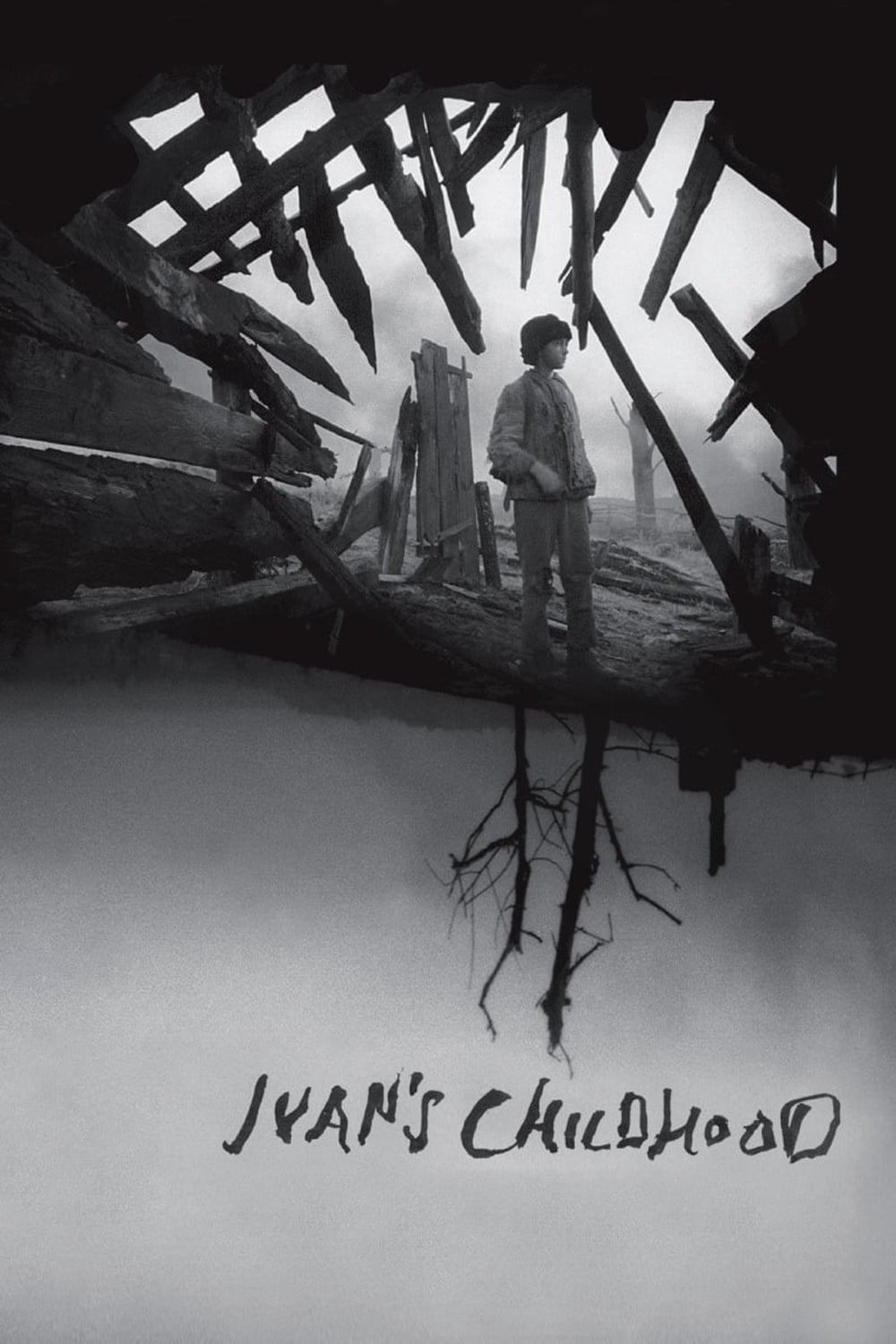
What endures in my mind are Tarkovsky’s tactile choices: the relentless rain, the mud, the gnarled trees reaching skyward, the rivers that seem to promise escape but wash only ruin downstream. Nature is not indifferent; it is a silent witness, reflecting Ivan’s turmoil and the erosion of human warmth. The recurring motif of water — sometimes a mirror, sometimes a barrier — blurs the boundaries between reality and reverie. These landscapes are not backdrops but living participants in Ivan’s story, expressing what language cannot. Through them, Tarkovsky constructs a world where beauty and despair bleed into one indistinguishable current.
The Absence of Fathers and the Weight of Mothers
For me, the absence of traditional family structures in “Ivan’s Childhood” is neither accidental nor merely circumstantial. Every adult Ivan encounters becomes a surrogate — a failed protector, a hesitant authority. The commandant, the doctors, the soldiers: each attempts to reclaim Ivan’s innocence or shield him from his chosen path, but none can break through. The memory of Ivan’s own mother — always just out of reach, luminous and gentle — is a symbol of the nurturing that the world has denied him. It is the cruelty of fate that Ivan’s missions are always solitary, the ultimate loneliness of a child conscripted into adulthood by grief.
Violence and Tenderness: The Duality of Surviving
Tarkovsky’s camera lingers not only on suffering but on small, human moments — the brushing of a horse, the lighting of a cigarette, the fleeting touch between two adults in the midst of carnage. These moments are not sentimental; they are fragments of normality embedded in the chaos, reminders that the soul survives in unexpected places. What moves me is how the film refuses to let war flatten its characters into mere victims. Ivan, despite everything, experiences wonder and affection — even if only in memory or imagination. Tarkovsky suggests that tenderness is not erased by violence, but made precious and tragic by its rarity.
Black-and-White Dreams and Cinematic Truth
The stark monochrome palette of “Ivan’s Childhood” is not just an aesthetic decision, but a philosophical one. By draining the world of color, Tarkovsky invites us to experience Ivan’s story as myth, as nightmare, as something both more and less real than documentary truth. The shadows play across faces, the white flash of a birch tree in the gloom, the glimmer of water, all become symbols of hope flickering against overwhelming darkness. This visual language is, for me, the deepest assertion of the film’s meaning: that trauma renders the world irreducibly strange and beautiful, and that cinema is uniquely equipped to communicate the textures of unendurable pain.
What Remains When the War Is Over
By the time the film’s devastating coda arrives, showing the aftermath not just for Ivan but for those who tried to protect him, I am left with a sense of hollowness that goes beyond the fate of any one character. “Ivan’s Childhood” is a lament, not just for lost children but for the world’s failure to shield what is fragile and irreplaceable in itself. Even in its moments of gentleness, the film never pretends that there is comfort to be found in understanding. Loss, Tarkovsky tells me, is not something that can be overcome — it is an environment we learn to breathe, a climate that shapes us forever.
Echoes in Other Shadows
If “Ivan’s Childhood” speaks to you as it does to me, I would suggest delving into the haunted landscapes of “Come and See” and the lyrical sorrow of “The Spirit of the Beehive.” Both of these films, in their own registers, wrestle with innocence ravaged by history and the ways children bear burdens too immense for words.
If you’re curious about how this film was originally perceived or how it compares to similar works of its era, these resources may be helpful.
🎬 Check out today's best-selling movies on Amazon!
View Deals on Amazon