
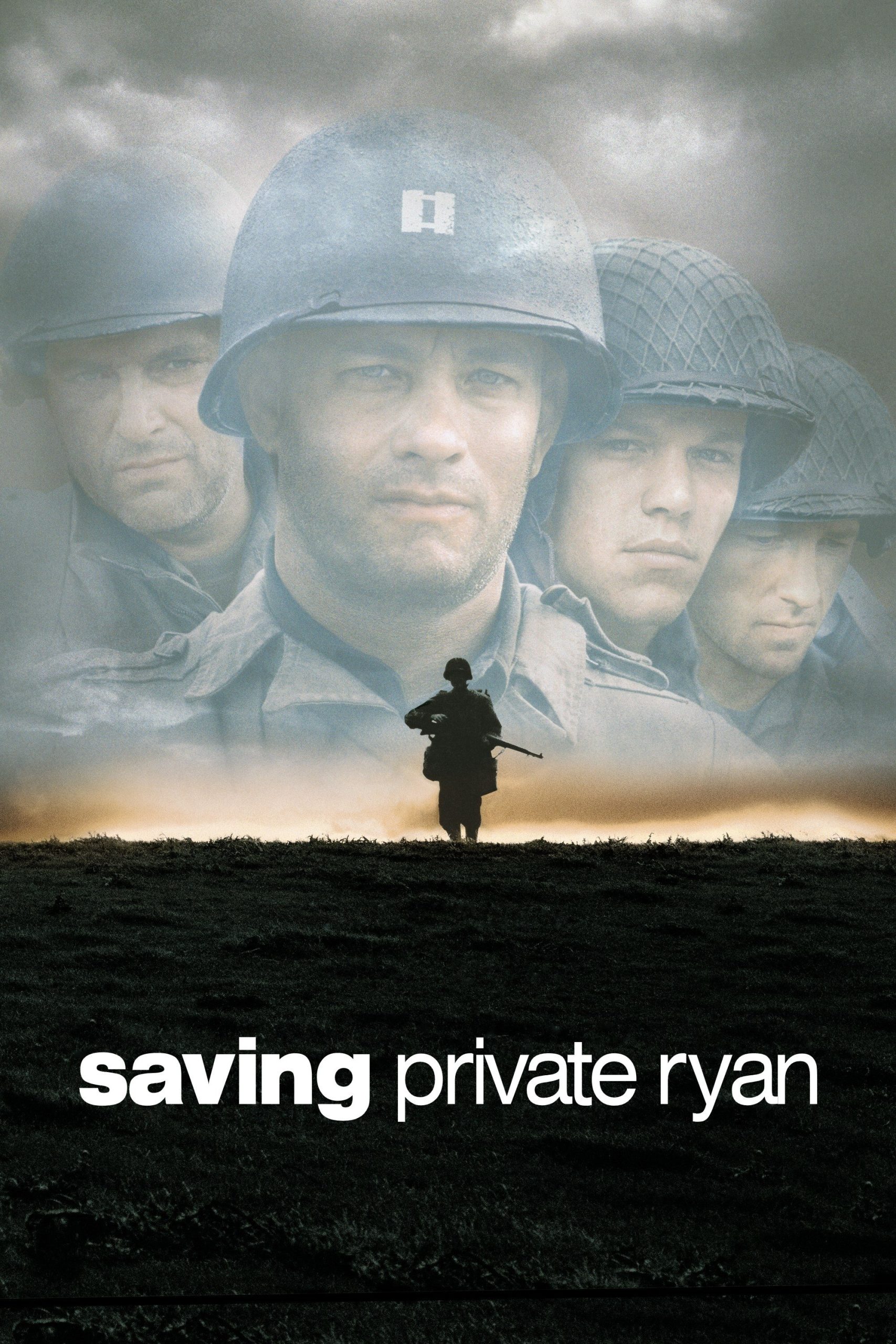
In all my years of watching and dissecting war films, no work has ever left me as shrouded in emotional exhaustion and trembling introspection as “Saving Private Ryan” did. There are films you remember as an experience—and then there are films that seem to imbed themselves into the fabric of your nerves, reshaping how you look at sacrifice, duty, chaos, and the small mercies of humanity. The first time I saw Spielberg’s 1998 epic as a budding cinephile, I staggered out of the theater, both overwhelmed and deeply unsettled, grappling with the idea that a Hollywood production could conjure up a sense of truth so bracing it threatened to dismantle my sense of narrative distance. That feeling has never entirely faded with subsequent viewings. If anything, my appreciation for the film’s contradictions and ambitions has deepened. This is less the chronicle of a mission—a plot of soldiers searching for a lost brother—and more a fevered, relentless meditation on moral cost, fragility, and the shreds of decency amid relentless brutality.
The Human Heart Amid Blitzkrieg
At its surface, “Saving Private Ryan” proposes a simple, even absurd premise: a squad of American soldiers, just days after the D-Day landings, is dispatched to find and escort home a single paratrooper whose brothers have all died in combat. Yet the emotional current of the film surges well beyond its narrative outline. Throughout the movie, I found myself asking, at every turn, what can possibly endure within the human spirit when the world around is torn asunder? Spielberg’s framing—intimately close yet grand in scale—compels me to inhabit field and fear along with these men, amplifying the genuine conflict between survivalist instinct and a longing for moral clarity.
The emotional journey here is less about triumph and more about erosion. Each character, especially through Tom Hanks’ indelible Captain Miller, seems to be performing a constant autopsy of their own values against a backdrop that punishes empathy at every turn. Watching them wrestle with their mission—questioning the worth of risking many lives for one—becomes a safari through the grayest zones of human feeling. Spielberg uses the search for Private Ryan as a device to force both his characters and audience to confront the very foundations of duty, identity, and compassion. For me, the conflict is never straightforward: it dwells in the subtle frictions, the groans of conscience, and the silences that linger over dead comrades and bitter choices.
The Weight of Conscience: Themes Revisited
When “Saving Private Ryan” premiered in 1998, I remember it being lauded as a technical revolution and a revitalization of the war genre. Yet, beneath the carnage and kinetic filmmaking, it’s the film’s interrogation of sacrifice, memory, and the price of survival that has lingered for decades. At its center stands the paradox: when is one life worth more than another? Is the heroism of war a convenient abstraction, or does it hide something darker—the arbitrary application of violence in the name of patriotism or love? I still find these questions fiercely resonant now, in an era where the consequences of war are scrutinized in pixelated headlines and social media feeds—sanitized, distant, yet ever urgent.
The film’s core theme, to me, is not merely the atrocity of war but the burden of living with one’s choices in its aftermath. Captain Miller’s shellshock, his trembling hands, and his desperate clinging to the vestiges of his former life as a schoolteacher, anchor the existential costs. The film suggests that meaning must be constructed, not inherited, amid the randomness of death. Importantly, Spielberg does not offer easy answers. The mission “to save Private Ryan” becomes a metaphor for the fragile project of salvaging some scrap of purpose—even grace—from the ruins. In 1998, this message likely resonated in the post-Cold War optimism, yet today, in a world desperate for certainty and redemption, I sense that the movie’s refusal to romanticize violence or easy closure feels refreshingly, almost painfully, honest.
The Blood and the Earth: Visual Poetry and Symbolism
I have long felt that “Saving Private Ryan” is as much a triumph of metaphor as it is of narrative. Spielberg and cinematographer Janusz Kamiński craft a wash of color and texture that feels at once documentary-real and almost hallucinogenic in its clarity; the persistent motif of mud, blood, and rain and the kaleidoscopic churn of earth and flesh elevate the film into a kind of harrowing, tactile poetry. It’s striking to me how the camera operates on the level of skin—raindrops streaking grime, trembling hands, a bloodied dog tag rhythmically thumbed—which becomes a language of disorientation, but also a persistent reminder of physical vulnerability.
Another recurring motif that always unsettled me is the American flag, which bookends the film—first, in a washed-out, tattered state, and finally, pulsing red, white, and blue against summer light. Far from being merely patriotic, the flag feels weighted with irony and uncertainty: is this emblem the sanctifier of sacrifice or just another marker of territorial violence? The dog tags, shuffled through with mechanical detachment by soldiers searching for Ryan, similarly become symbols of how identity is reduced and cataloged. Perhaps the most quietly potent symbol, though, rests in Miller’s trembling hand—a motif for the inner damage that persists and refuses neat resolution. Every time I revisit that gesture, I’m reminded that the deepest wounds of war are not always visible or easily articulated.
Shattering Stillness: Defining Moments That Resonate
Omaha Beach: The Birthplace of Cinematic Realism
No discussion of “Saving Private Ryan” can begin anywhere but Omaha Beach. That 24-minute sequence is, in my estimation, one of the most technically innovative and emotionally grueling achievements in the history of film. Spielberg’s unwavering handheld camerawork, the blurred chaos, and the fragmented soundscape (bullets as ricocheting thunder, waves swallowing screams) drag me into the pulverized mud along with the soldiers. For the first time, I felt a war movie not only wanted me to watch but to experience, in tactile horror, the cost of a single military maneuver. The brutal randomness of death—the medic who dies saving another, the confusion of friend and enemy—destroys any vestige of cinematic glamour. This sequence alone, in its raw immediacy, argues against any simple valorization of combat. I still shudder thinking about the stunned, animal confusion in the soldiers’ eyes—Spielberg’s greatest technical feat is to bring that recognition of mortality so close that it enters the bone.
The Church of the Fallen: Fragile Brotherhood
After the carnage of the beach, the squad seeks sanctuary in a battered church. It’s here that “Saving Private Ryan” changes registers, allowing introspection to creep in. What has lodged within me every time I revisit this scene is the tentative connection and mourning these battered men share. Mellish and the others express their longing for home, their fear of meaninglessness, and their need to anchor themselves in ‘stories’—of family, lost loves, and mundane pre-war rituals. Spielberg’s camera slows, and so does my heartbeat, as light filters through broken stained glass, evoking a ruined sanctuary both literal and spiritual. The church, for me, symbolizes both the loss of innocence and the urgent will to find or invent meaning amid devastation. These moments of quiet are rare, fragile testimonies to brotherhood that, in their brevity, only accentuate the omnipresence of death.
The Bridge and the Question of Worth
The film’s climax—in which the battered remnants of the company defend a strategic bridge waiting for reinforcements—becomes, for me, a jaw-clenching meditation on the arbitrariness of fate and the consequences of duty. Every choice reverberates: Upham’s paralysis in the face of an execution, Miller’s death uttering the plea to “earn this.” The scene is charged with suspense, but what devastates me most is the aftermath—the orphaned silence as Tom Hanks’ Miller, dying, bequeaths a burden, not a victory, to Private Ryan: that his survival should be justified by a lifetime of moral effort. This, to me, turns the film inside out. Heroism here is not reward but a debt to the dead—an ethical challenge that echoes, unsettlingly, through decades afterward. It obliterates patriotic triumphalism and replaces it with the gnawing ache of responsibility. Rarely have I felt a movie’s final moments weigh so heavily long after the credits.
Between Conventional Wisdom and My Own Reckoning
Over the years, I’ve read countless interpretations of “Saving Private Ryan.” The critical consensus rightly emphasizes its historical realism, technical audacity, and unvarnished depiction of combat. Many reviewers in 1998 lauded it as a necessary corrective to the romanticized canon of earlier war films, seeing it as a visual indictment of violence and a tribute to the Greatest Generation. Some, less convinced, have critiqued its narrative conceit—the idea that risking many for one borders on patriotic myth-making or even absurdism. Others see in it the seeds of jingoistic sentimentality that Spielberg sometimes harbors, especially in his later work. All these readings ring partly true to me, but none feel complete.
My own response is more restless and contradictory. Where others focus on realism and technical bravura, I find myself obsessed with the movie’s uneasy emotional shadows. For me, “Saving Private Ryan” is not a simple anti-war or pro-valor tract; rather, it dwells uncomfortably in the tragic absurdity of war—the way it both erases and demands meaning. The film’s refusal to offer closure, the persistent return to an older Ryan questioning if his life was “enough,” strikes me as braver and sadder than its surface might suggest. I remain haunted not by the violence, but by the aftermath—the sense that every act of survival incurs an unpayable debt. My principal critique is that Spielberg sometimes leans too hard on sentiment, especially in the final cemetery refrain, but even here, the rawness of what precedes earns him a degree of indulgence. No tidy reading or critical consensus can diminish the ambivalence I feel: admiration, unease, and profound gratitude that a work of so much scale can still allow so many doubts to breathe within it.
In the Company of Echoes: Films of Kindred Spirit
- Paths of Glory (1957, Stanley Kubrick) – An unflinching look at military bureaucracy and the expendability of men, whose cynicism and compassion eerily echo Spielberg’s themes.
- The Thin Red Line (1998, Terrence Malick) – Released the same year, Malick’s poetic counterpoint to Spielberg’s realism examines the philosophical and spiritual costs of combat.
- Come and See (1985, Elem Klimov) – A Soviet masterpiece of immersive horror, it stands with “Saving Private Ryan” as a viscerally destabilizing meditation on innocence, loss, and the cruelty of war.
- 1917 (2019, Sam Mendes) – A technical achievement in immersive single-take storytelling, it explores similar themes of brotherhood and the compulsion to find meaning in chaos.
Finding Relevance in Today’s Tattered World
To watch “Saving Private Ryan” now is to recognize that, even as our collective memory of World War II grows distant, the questions it wrestles with—about sacrifice, duty, memory, and the cost of survival—retain their sting. Spielberg’s insistence on immersing us in both horror and brief grace keeps the film vital in a climate where war, even in its digital abstraction, continues to shape our world. Every frame presses me to consider anew what it means to “earn” the privileges of peace—how every act of rescue, compassion, or even remembrance is fraught with the debts of history. In this sense, the film remains urgently alive, a challenge to sentimentality and a bracing prayer for accountability.
If This Resonated With You
If you found value in my perspective on “Saving Private Ryan,” you may also be interested in my analyses of “The Thin Red Line” and “Paths of Glory.” Both interrogate the costs of war through radically different lenses, and each offers its own vocabulary of suffering, beauty, and conscience.
To broaden this interpretation, you may also explore how critics and audiences responded over time.
🎬 Check out today's best-selling movies on Amazon!
View Deals on Amazon